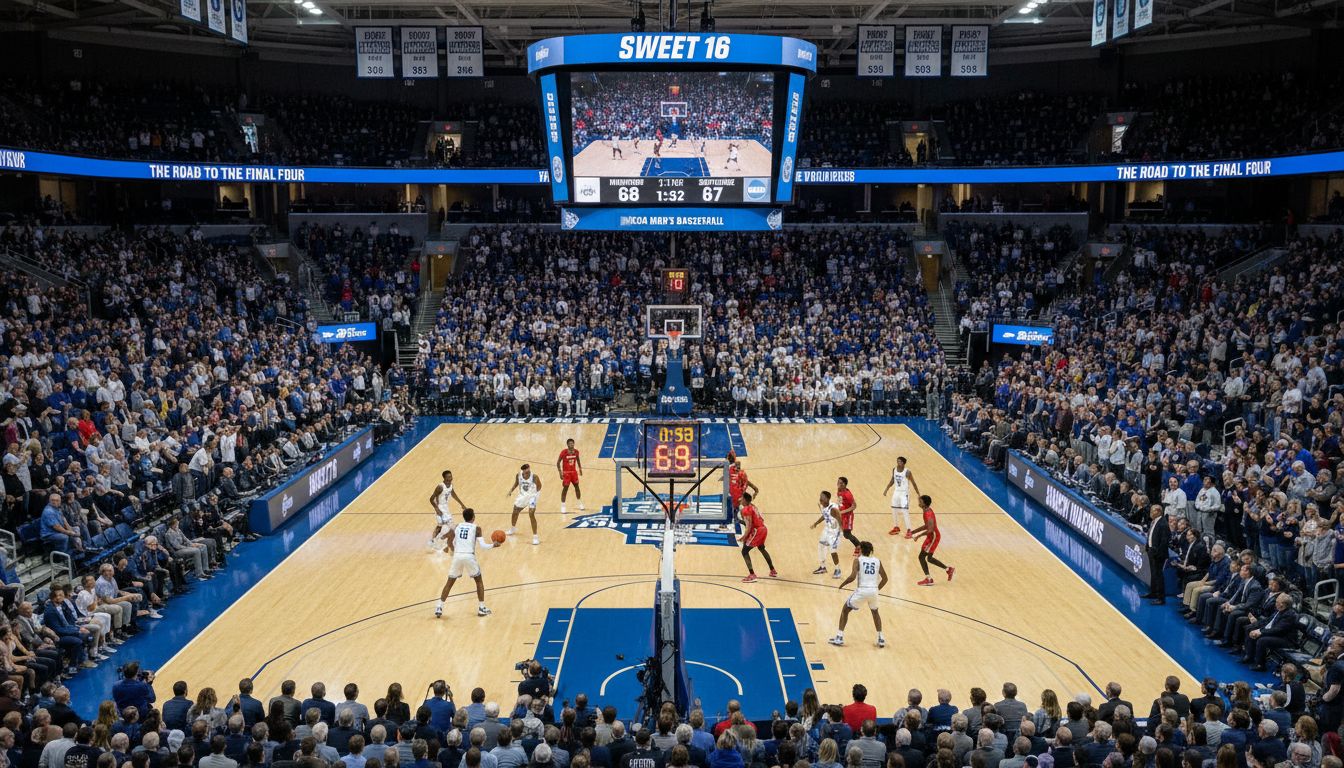
Walk into any gym in Indiana this week, from a Bloomington church league to the high school cathedrals along State Road 37, and you can feel it: March has its hooks in us again. The 2026 Sweet 16 is set, and for the second straight year it is an all high-major affair, a field with just one double-digit seed and not a single classic Cinderella in sight. Yet if there is one thing a lifetime around Assembly Hall will teach you, it is that history and heart don’t care much about seed lines. What this bracket lacks in mid‑major charm, it more than compensates for in storylines, continuity, and a few redemption arcs that would make even a grizzled Big Ten skeptic smile. Let’s walk region by region through the remaining teams, not to anoint favorites, but to understand why every one of these programs has earned at least a tip of the cap from those of us who grew up measuring winters by how loud the radio got in March.
We begin, appropriately for a Hoosier, in Big Ten country, where Iowa and Nebraska meet in a Sweet 16 that feels part tournament game, part family reunion at the county fair. Iowa’s story starts with Ben McCollum, a first‑year high‑major head coach whose résumé looks like something you’d sketch on a napkin if you were daydreaming about the perfect hire. Four Division II national titles at Northwest Missouri State, 32–7 in that tournament, then a 31‑win stop at Drake and now Iowa’s first Sweet 16 since 1999: the man simply wins, and Midwestern programs notice that sort of thing. His Hawkeyes play with the kind of disciplined spacing and composure that older Big Ten fans will recognize, even if the shot charts look more like modern art than 1976 Indiana’s. Across from them, Nebraska is making the first Sweet 16 trip in program history, a sentence that still looks strange on the page given how long the Cornhuskers have lived in the neighborhood without tasting March success.
What makes Nebraska’s run so endearing is not just the history, but the texture of it: this was the last high‑major program without an NCAA Tournament win, and now it has two in a single whirlwind weekend. In a sport where rosters turn over faster than an Indiana weather forecast, there is something wonderfully old‑fashioned about a father‑son pairing at the heart of this breakthrough. Fred Hoiberg on the sideline and his son Sam, once a walk‑on and now a key contributor, give Nebraska’s story a bit of that backyard driveway feel—only with 18,000 people watching and television timeouts. If you want a rooting interest rooted in fresh history being written in real time, this is your team. And for those of us who have watched the Big Ten fight its way through March for decades, a league matchup in this round is a reminder that conference banners matter less now than they did in the Knight era, but the rivalries still travel.
Elsewhere in the bracket, Illinois and Houston offer a different sort of contrast—depth versus destiny. Illinois arrives with star freshman Keaton Wagler drawing NBA scouts by the row, but what sustains the Illini is their ability to play eight deep without a significant drop‑off. When Andrej Stojaković, nominally their third‑leading scorer, can slide to the bench and still erupt for a team‑high 21 points in a tournament win, you’re looking at a roster built to withstand foul trouble, cold shooting, and the emotional turbulence of March. Houston, by contrast, is powered by a very specific kind of hunger. A year ago the Cougars were one solid possession from a national championship against Florida and never even managed to get a shot up; for a veteran coach like Kelvin Sampson—well known in this state from earlier chapters of his career—those final seconds linger.
This Houston group might be his best answer yet to that haunting finish, led by freshman guard Kingston Flemings alongside returners Milos Uzan, Emanuel Sharp and Joseph Tugler. Seven straight trips past the first weekend speak to a level of consistency that old Big Ten purists secretly admire, even if they might grumble about pace and floor spacing while they do it. If you believe in the long arc of a program bending toward redemption, the Cougars will appeal to you. They are the reminder that sometimes the ball really does bounce back to the coaches and players who stayed the course after heartbreak, an idea that resonates in a state that still tells and retells the story of 1987 and 2002 with equal vigor. Whether Illinois’ depth or Houston’s accumulated scar tissue proves decisive, this matchup captures something essential about modern March: you need stars, you need role players, and you need the emotional resilience to play through ghosts.
Turn east and you find Duke and St. John’s staging an old‑school brand showdown with thoroughly modern personnel. Duke’s Cameron Boozer has become the central individual figure of this tournament—the presumptive National Player of the Year, a projected top‑three pick, and the best NBA prospect left in the field after BYU’s AJ Dybantsa and Kansas’ Darryn Peterson exited early. His numbers—22.4 points, 10.3 rebounds, 4.2 assists per game—read like something out of a video game, and if he tacks a national title onto that stat line, the debates about the greatest one‑and‑done seasons will heat up from Durham to every corner bar with a bracket pool. For some fans, that’s reason enough to tune in: March as a showcase of future professional greatness. On the other sideline, St. John’s wins hearts not with a singular star, but with sweat equity and a 94‑foot defensive identity that would make any coach from the old Big Ten smile—and then worry about his ball handlers.
Under Rick Pitino, the Red Storm harassed Kansas into struggling just to inbound the ball, their full‑court pressure turning routine possessions into small crises. Seen in person, their physicality is even more striking than it appears on television; they play defense as if the court is slightly smaller for their opponents than it is for them. If you are the sort who secretly enjoys a 62–58 grinder now and then, St. John’s might be your late‑March muse. There is a certain satisfaction in watching a team defend every inch of the floor, especially in an era when offensive freedom of movement often takes center stage. Between Boozer’s star turn and the Red Storm’s relentless press, this game reminds us that March allows both individual brilliance and collective grit to share the same stage—and that each can be beautiful in its own way, as anyone who remembers Indiana’s defensive clamps in the 1970s can attest.
Further up the bracket, UConn and Michigan State bring us back to the realm of dynasties and dunks. Dan Hurley’s Huskies missed their shot at a three‑peat last year when Florida bounced them in the second round, but the idea of three titles in four seasons still hangs in the air. The last time we saw anything close to that kind of sustained dominance, John Wooden’s UCLA teams were winning 10 national titles in 12 years—a feat no one expects to see replicated in the transfer‑portal era. Still, three in four is the kind of historical company that gets even us old‑timers to raise an eyebrow and put down the box score for a second. Michigan State, for its part, comes armed with perhaps the best dunker in college basketball in forward Coen Carr, who has turned fast breaks into nightly auditions for the rim’s structural integrity.
Carr’s 12 points per game only hint at his impact; his above‑the‑rim plays shift momentum, wake up arenas, and remind those of us who grew up on motion offense that there is room in the game for a little spectacle. Tom Izzo’s teams have long been defined by rebounding, toughness, and March reliability, and this version adds a flair that makes them particularly fun to drop into on a Thursday night. The UConn‑Michigan State clash is as much a referendum on the possibility of modern dynasties as it is a basketball game. If the Huskies keep rolling, we will be forced to expand our historical vocabulary beyond the Wooden era; if the Spartans derail them, it will feel like another instance of March insisting that no one program can own this month for too long. Either way, it is a game that encourages you to think about the sport not just as a season, but as a series of overlapping eras.
Out west, Arizona and Arkansas offer a study in youthful firepower from different angles. Arizona leans on one of the most potent freshman duos in Koa Peat and Brayden Burries, the top scorers on a roster that has grown comfortable with their talents. Burries, a likely lottery pick, leads the team in scoring, while Peat announced himself in November with a 30‑point outburst against the defending national champions, a debut that would fit comfortably in any program’s lore. Arkansas counters with the dynamic guard play that coaches have been preaching as the key to March wins since long before the three‑point line arrived. Darius Acuff Jr. has already poured in 60 points across his first two NCAA Tournament games, the most ever by a freshman over that stretch, and holds the second‑highest single‑game scoring mark by a freshman in tournament history with 36 points.
Add to that his jaw‑dropping 49‑point regular‑season outburst against Alabama, and you have the kind of guard who can, on the right night, single‑handedly rearrange a bracket. The fact that this is the first Sweet 16 matchup in which both teams’ top two scorers are freshmen speaks to how thoroughly the sport has embraced youth, for better and for more volatile. For those of us who remember four‑year starters as the backbone of great teams, it can feel disorienting, but it is also thrilling: every March now brings a new crop of freshmen capable of rewriting the record book before midterms. Arizona‑Arkansas crystallizes that reality in one game, a reminder that the sport’s future is quite literally on the floor. Some might pine for the stability of older rosters, but no one can deny the energy that nights like these bring to the tournament.
Back in Big Ten orbit, Texas and Purdue square off in another game soaked in contrasting identities. Texas arrives as the lone double‑digit seed in the Sweet 16, having taken the long road from the First Four to this stage, a path only five other teams have traveled before. But don’t mistake that seed line for a glass slipper; with Sean Miller on the sideline and high‑end talent on the floor, these Longhorns are less Cinderella, more late‑arriving guest who insists on staying until the music stops. Purdue, on the other hand, represents something increasingly rare in the portal era: a core that actually stayed together. Braden Smith, Fletcher Loyer and Trey Kaufman‑Renn have spent four seasons as the heartbeat of this program, culminating (so far) in Smith setting the NCAA assist record last week, a mark that could sit in the books for quite some time.
For fans who value continuity—and there are many of us in Indiana who do, steeped as we are in tales of rosters that grew together year by year—Purdue’s journey is an encouraging counterpoint to the idea that you must reinvent yourself every April to survive. Their presence in this Sweet 16 underscores that you can still build around a long‑term core in the modern game, even if it takes patience, persistence, and the occasional lump in March. Texas, meanwhile, embodies the other pathway: retool aggressively, lean into volatility, and trust that if you get hot at the right time, the seed next to your name becomes just another number on the screen. The beauty of their matchup is that both philosophies can be right for the programs that choose them, and the tournament gives us 40 minutes to watch them collide. Somewhere, I suspect, a few old‑school coaches are nervously evaluating their own playbooks while they watch.
On the other side of the bracket, Michigan and Alabama collide in a meeting of frontcourt giants versus backcourt fireworks. Michigan’s turnaround under Dusty May has been one of the more striking recent stories: from eight wins to a Sweet 16 in 2025, and now back again with an even more imposing frontline. Yaxel Lendeborg, Aday Mara and Morez Johnson Jr.—all 7‑footers, all transfers—form a towering trio that leads the Wolverines in scoring and presents matchup nightmares on both ends. That three players of that size and impact arrived from three different schools only to mesh this quickly says something about May’s ability to choreograph a crowded paint without stepping on too many toes. It also reflects the new reality of roster building: even a frontcourt that looks like it was assembled out of a 1980s coaching fantasy can come together in a single offseason.
Alabama, by contrast, wins with pace and points, leading Division I in scoring at 91.6 points per game. Under Nate Oats, the Crimson Tide have made high‑octane offenses their signature, and this year is no exception. Guard Labaron Philon Jr. sets the tone with 21.6 points per game, but Alabama’s challenge this March has been redistributing responsibility after the loss of Aden Holloway, who was arrested on felony drug charges and missed the tournament’s opening weekend. On the floor, that absence has forced the Tide into a deeper exploration of their offensive options; off the floor, it is a sober reminder that college basketball stories do not exist in a vacuum, however much we might wish they did for a few hours each night. For the neutral fan, this matchup offers a classic stylistic contrast: can Michigan’s size dictate tempo, or will Alabama’s speed stretch the game into the 90s and beyond?
Finally, Iowa State and Tennessee close out the Sweet 16 slate with a meeting defined by shooting on one side and history’s weight on the other. Iowa State forward Milan Momcilovic is authoring one of the greatest shooting seasons the college game has ever seen, hitting 49.3% of his 7.6 three‑point attempts per game. If he maintains that rate past 250 attempts, he will eclipse the NCAA record held since 2006–07 by Northern Arizona’s Stephen Sir, a feat that would normally command far more national attention than a shooter in Ames typically gets. For those who appreciate the geometry of the modern game—the way one elite floor‑spacer can warp a defense—Momcilovic is a delight. The Cyclones’ offense orbits his gravity, and every catch beyond the arc carries the potential to swing a game or a season.
Tennessee, meanwhile, is chasing something far more elusive than a single‑season record: the program’s first Final Four appearance. Rick Barnes last reached that stage with Texas in 2003, but the Volunteers have never punched through despite four straight Sweet 16s and back‑to‑back Elite Eight runs. At 71, Barnes coaches with the calm of a man who has seen just about everything the sport can throw at him, yet there is an unmistakable urgency around this particular group. If you find yourself drawn to long‑suffering hopes finally threatening to ripen, Tennessee’s quest may tug at you. It captures one of the quiet truths of March: behind every highlight and every upset, there are careers and fan bases measuring time not just in wins and losses, but in the slow, sometimes frustrating pursuit of that one breakthrough weekend.
Taken together, this Sweet 16 field may lack the mid‑major underdog that casual fans cling to each year, but it is rich with stories that reward a closer look. From Nebraska’s first steps into tournament relevance to UConn’s flirtation with modern dynastic status, from Purdue’s old‑fashioned continuity to Alabama’s turbo‑charged offense, every team still dancing carries a narrative that stretches beyond one season. For those of us raised on tales of undefeated runs and Assembly Hall magic, March has always been about more than just brackets; it is a living history lesson in how programs evolve, adapt, and occasionally surprise even their own faithful. You don’t have to choose a favorite to appreciate that. This year, perhaps the best way to watch is the most old‑fashioned: settle into your chair, listen for the swell of the crowd, and let each game tell you why it matters, one possession at a time.