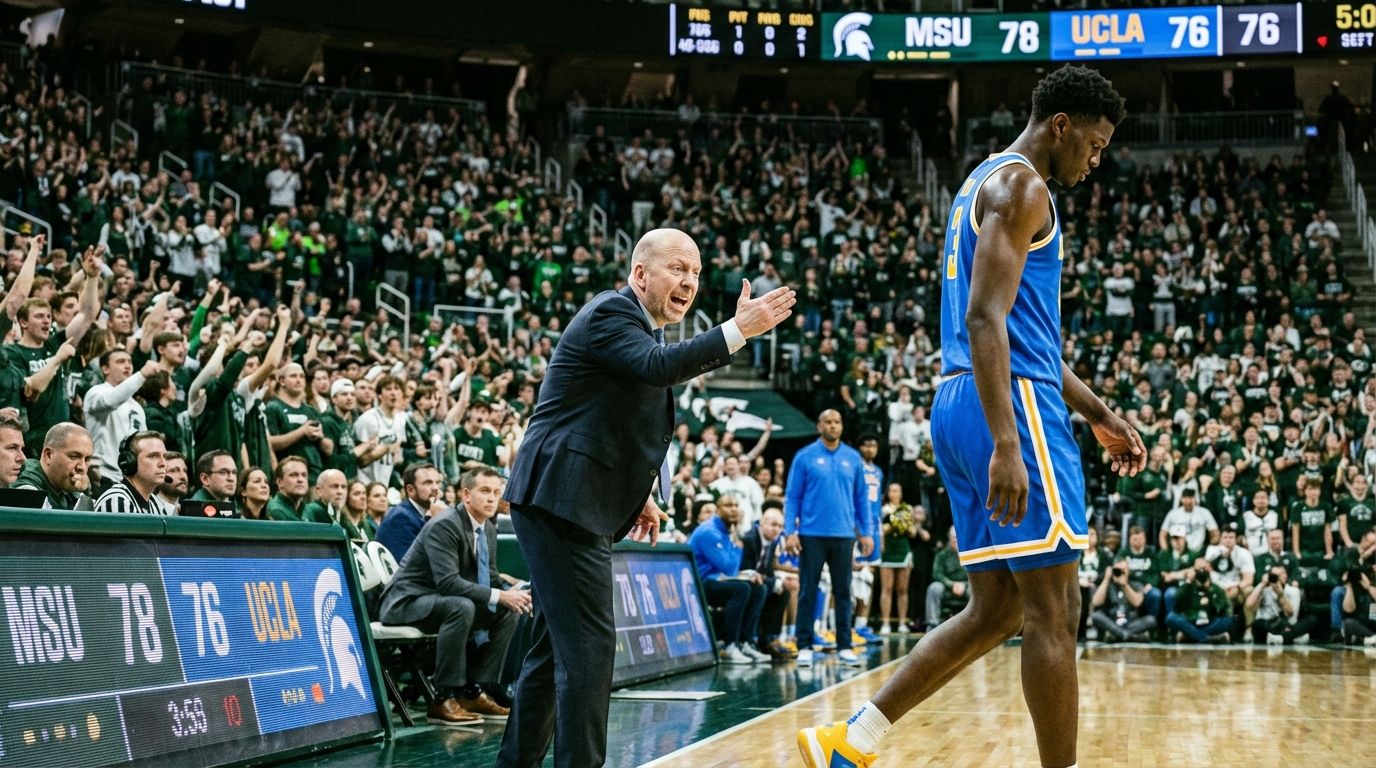
On a cold February night in East Lansing, with UCLA already buried under a double–digit deficit, Mick Cronin did something you almost never see in big–time college basketball: he benched his own player for good, mid–game, before the officials could even finish reviewing the tape. Center Steven Jamerson II had just committed a hard transition foul on Michigan State’s Carson Cooper, then gone chest–to–chest with him as tempers briefly flared. While the referees headed to the monitor to decide whether this was a flagrant one or a flagrant two, Cronin rendered his own verdict. He grabbed Jamerson by the jersey, pointed him toward the tunnel, and had a team staffer escort him off the floor. In a season full of emotional moments across college hoops, this one stood out because it raised bigger questions about coaching, control, and what we really mean when we talk about “playing the right way.”
To understand why Cronin’s decision landed with such force, you have to see it in the broader context of UCLA’s week from basketball purgatory. Three days earlier, the Bruins had been dismantled 86–56 by top–ranked Michigan, their worst loss in years. Any hope that the drubbing in Ann Arbor was a one–off disappeared in East Lansing, where Michigan State rolled to an 82–59 win behind blistering three–point shooting and a masterful 16–point, 10–assist night from Jeremy Fears Jr. By the time Jamerson’s foul occurred with 4:26 left, UCLA trailed by 27 and had been outclassed in just about every phase. Coaches like to talk about “sending a message,” and there’s no question that’s what Cronin was doing—for his team, his locker room, and maybe for the cameras, too.
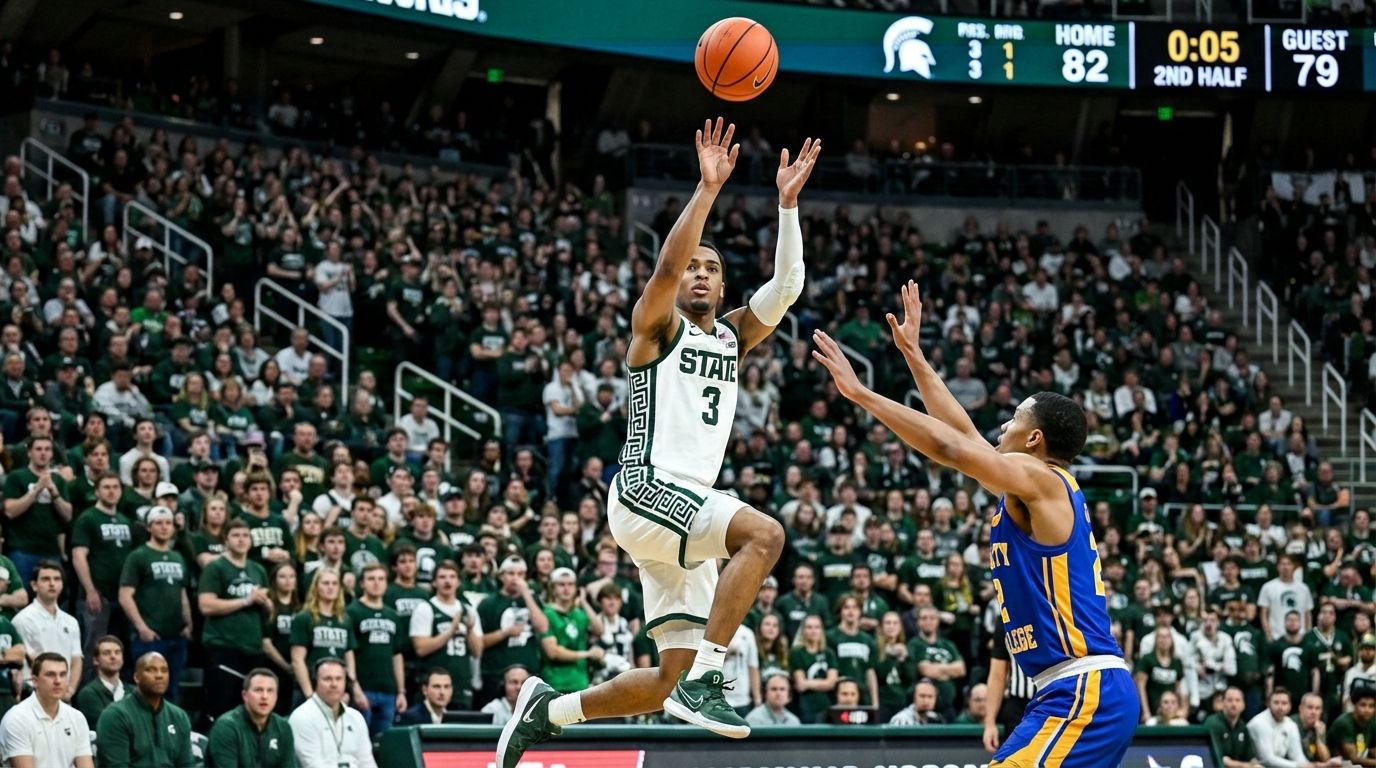
From a neutral vantage point, the game itself told a pretty straightforward story. Michigan State, licking its wounds after a recent skid, looked sharper, more connected, and far more confident than a UCLA group that had actually been playing decent basketball before their trip to the Great Lakes. The Spartans hit 14 of 27 threes, with Fears drilling four of them and Coen Carr chipping in 16 points as they stretched the Bruins’ defense to the breaking point. UCLA’s Tyler Bilodeau battled to 22 points, but he was a lone bright spot until Skyy Clark’s late scoring pushed him into double figures. The Bruins have now dropped back–to–back games by 20 or more points for the first time since the 1944–45 season—a stat that tends to grab your attention even if you’re usually busy tracking ACC box scores.
What made Jamerson’s ejection so jarring is that it cut against the usual script we’ve grown used to in modern college hoops. Typically, a hard foul followed by some jawing yields a lengthy review, a flagrant call of some variety, and then a stern postgame lecture from the coach about composure and representing the program. Here, Cronin skipped right past the public relations choreography and enacted his own in–house discipline in real time. Spartans coach Tom Izzo, who has been around enough sideline fireworks to appreciate the moment, quipped afterward, “I guess he upgraded that to a flagrant two,” adding that it sounded about right for Cronin’s fiery personality. When another coach—especially an old–guard Big Ten coach—calls it something he’s never seen before, you know you’ve entered unusual territory.
Now, speaking as someone who grew up steeped in Dean Smith’s Carolina Way, I carry a particular lens into these moments. At Carolina, toughness has always been expected, but it’s rarely been confused with public humiliation. Smith built his legacy on accountability, no doubt, but also on a deep respect for his players as students and human beings first, even when they messed up on national television. From that vantage point, Cronin’s move looks like a complicated cocktail: part real–time standards enforcement, part emotional overflow, and part sideline theater in the middle of a blowout that already felt out of hand. It’s one thing to sit a player; it’s another to physically tug his jersey, send him to the locker room before the refs reach their decision, and leave him jogging off the court to the soundtrack of opposing fans waving him goodbye—at the school where he began his college career, no less.
There’s also a student–athlete dimension here that gets lost if we reduce this to a meme about an “angry coach” or a punchline about Cronin’s temper. Jamerson is a senior, playing what is likely his last season of college basketball, in front of a fan base that once saw him as one of their own. In that light, the power imbalance of the moment becomes hard to ignore: an adult in a position of authority asserting control over a young player’s body and image in a very public way. Did Jamerson’s foul and post–whistle reaction warrant discipline? Probably yes—especially if Cronin has been clear behind closed doors about expectations for composure. But there’s a big difference between holding someone accountable and making them the symbol of everything going wrong during a brutal road trip.
To be fair, coaches occupy a nearly impossible space these days, especially at the high–major level. They’re judged in real time on television, scrutinized on social media, and pulled between multiple constituencies—administration, boosters, alumni, and players—each with their own definition of what leadership should look like. A coach who doesn’t react strongly risks being labeled soft; a coach who does what Cronin did risks being seen as performative or even punitive. It’s a narrow ridge to walk, and different coaching trees have different instincts about where to plant the flag. In the old ACC, you learned to value the quiet, behind–the–scenes conversation as much as the sideline stomp, and those habits die hard for those of us who still see the game through that prism.
None of this erases the basketball reality that UCLA has to confront when they leave Michigan’s snow behind. After briefly stabilizing their season by winning five of six, the Bruins were outshot, out–rebounded, and out–executed by both Michigan and Michigan State. Freshman guards struggled to keep shooters in front of them, ball pressure didn’t bother the Spartans’ backcourt, and defensive rotations broke down repeatedly as threes rained down. On the other end, Bilodeau’s 22 points mostly came from grinding in tough spaces rather than from crisp offensive structure. Cronin’s program has been built on defensive toughness and disciplined execution; over these two games, it was the other side dictating terms from the opening tip.
For Michigan State, the night felt more like a recalibration than a revelation. Jeremy Fears Jr. looked every bit the floor general Spartans fans have been waiting on, manipulating ball screens, finding shooters, and showing the poise of a player who has already logged far more minutes than his age suggests. Role players like Coen Carr, Carson Cooper, and Jordan Scott all slid neatly into their lanes, giving Izzo the kind of balanced box score he has long prized. After a rough stretch that dropped them in the AP poll, this was the kind of performance that can reset a season and restore a locker room’s belief. If the Bruins flew home with heavy questions, the Spartans walked out of the Breslin Center feeling like themselves again.
So where does that leave Cronin, Jamerson, and a UCLA team that suddenly looks shaken heading into the stretch run of conference play? The immediate work is tactical—shore up the perimeter defense, find more consistent help for Bilodeau, and steady a rotation that’s been rattled by travel, pressure, and lopsided scoreboards. But there’s also relational work ahead: making sure that a teachable moment for one player does not calcify into a lasting fracture between coach and team. The best programs, and I’ll unapologetically point to Chapel Hill here, find ways to turn even the ugliest nights into shared resolve rather than individual blame. If Cronin can take the spirit of his message—this isn’t who we are, this isn’t how we compete—and translate it into quieter, more constructive conversations back in Los Angeles, then this surreal February scene might become just one strange footnote in a season that ultimately bends back toward growth.