Every March, out here in Big 12 country, we keep one eye on our own bracket path and another on the coaching chessboard unfolding across the sport. This year, a fascinating subplot comes not from Lawrence or Lawrence’s favorite villains in Columbia, but from East Lansing and Storrs. Tom Izzo, the iron man of Michigan State, recently pulled back the curtain a bit on conversations he had with UConn’s Dan Hurley when the Los Angeles Lakers dangled a six-year, $70 million offer in 2024. On paper, that’s the kind of deal that makes even a lifer look twice, the sort of NBA call that could pull a coach away from almost any college campus. But as Izzo told it, what was really at stake wasn’t just money or market size; it was the question every elite college coach faces now: where is this sport headed, and where do I want to stand when it gets there?
Izzo admitted he told Hurley to take a serious look at the Lakers job, and that alone should make college fans sit up a little straighter. Here’s a Hall of Famer who has spent a career turning down NBA chances, from the Cleveland Cavaliers to the Atlanta Hawks, now advising another coach to at least consider jumping. That’s not panic talking; that’s a seasoned read on how quickly the college landscape has shifted with NIL, the transfer portal, and year-round roster churn. Yet in the same breath, Izzo said he’d hate to lose Hurley to the pros because, in his words, Hurley is “all that is right about college basketball.” There’s a quiet tension in that comment—an acknowledgment that the system is wobbling a bit, but also a stubborn belief that there are still a few anchors holding it steady.
Hurley, 53 and in his eighth season at UConn, has done more than just ride a hot streak; he has built a machine that travels in March as well as any in the country. Back-to-back national titles in 2023 and 2024 put him in rare air, and his 17-5 NCAA tournament record—77.3%—ranks first among active coaches and fourth all time for anyone with at least 15 games. That’s not simply talent acquisition; that’s game-planning, culture, and a staff that knows how to prepare for the short-turnaround crucible of the tournament. If you’ve watched enough March basketball from the bleachers of Allen Fieldhouse or the couch in a Kansas living room, you recognize the familiar traits: teams that guard, share the ball, and don’t blink in the last four minutes. Those habits don’t grow in a week; they come from a coach who is as demanding on Tuesday in January as he is on Sunday in April.
Part of what Izzo sees in Hurley traces back to family roots, and that strikes a chord for anyone who grew up on stories of coaching legends handed down like church hymns. Hurley’s father, Bob Hurley Sr., built a dynasty at St. Anthony High School in Jersey City, stacking more than two dozen state championships and sending dozens of kids on to Division I programs. That kind of lineage doesn’t guarantee success, but it does tend to produce coaches who see the game as more than a stepping stone to an NBA bench. When Izzo says Hurley “cares about the kids” and “cares about the game,” he’s talking about that old-school ideal where player development, teaching, and accountability sit ahead of shoe deals and social media clout. In a sport that now runs on transfer paperwork as much as jump shots, that ethos matters, even if it sometimes feels like a relic.
Izzo, of course, has his own ironclad résumé, one that’s as much about consistency as it is about cutting nets. He has guided Michigan State to a record 28 consecutive NCAA tournament bids—almost three straight decades of hearing their name called on Selection Sunday. His 2000 national championship remains the last won by a Big Ten team, a stat that probably says as much about the league’s collective heartbreak as it does about his singular success. On top of that, eight Final Four appearances have made Izzo synonymous with March, right up there with the likes of Mike Krzyzewski, Roy Williams, and yes, from where I sit, Bill Self. When you coach that long and that well in one place, you stop being just a program figurehead and start becoming part of the building’s foundation, the way Phog Allen’s name lingers in our rafters.
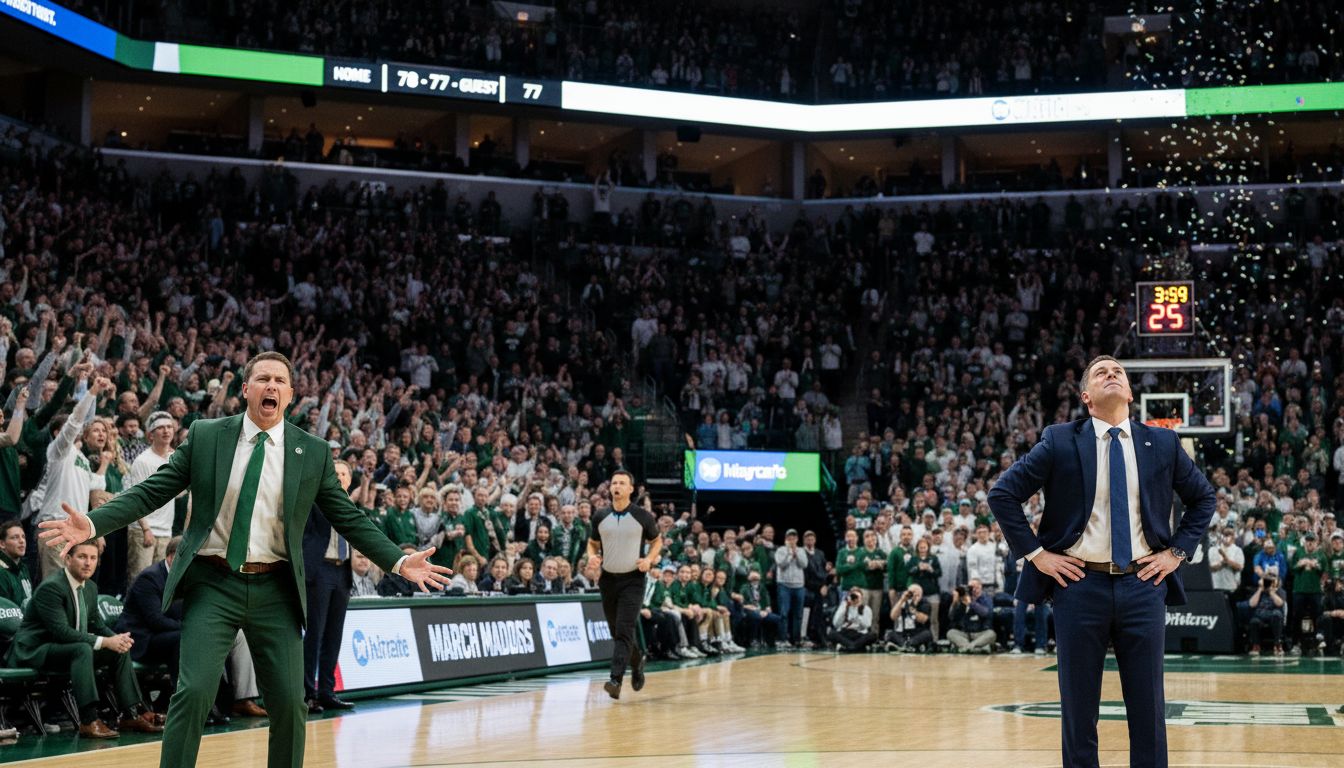
This week, those two coaching lifers—one in green, one in navy and white—meet on the floor in Washington, with Izzo’s third-seeded Spartans trying to derail Hurley’s second-seeded Huskies in the Sweet 16. On the surface it’s just another high-level March matchup, but underneath it’s a clash of philosophies that actually line up more than they diverge. Both coaches preach toughness, both build around defense and rebounding, and both still talk about teaching and accountability like they’re non-negotiables, not quaint throwbacks. From a neutral seat in Big 12 country, you can respect how their programs echo some of the same principles that have carried Kansas through eras of realignment, rules changes, and everything else the sport has thrown at it. It’s a reminder that, even in an age obsessed with “brand” and “content,” there’s still space for coaches whose identity starts with practice habits and locker room standards.
The NBA question will never fully go away for coaches like Hurley, and Izzo’s advice hints at why it’s no longer a simple yes-or-no proposition. On one hand, the pro game offers stability in some areas—a salary cap instead of NIL bidding wars, contracts instead of constant recruiting pitches, and rosters that don’t evaporate each offseason. On the other hand, college still offers something the pros can’t quite match: the chance to build a program that belongs as much to a campus and a community as it does to a win-loss column. From Lawrence to East Lansing to Storrs, that bond between coach, arena, and town is what makes a place feel like more than just a stop on the career ladder. For fans, it’s why we care whether someone like Hurley stays or goes; not because we begrudge anyone a payday, but because we understand how rare it is to find a coach who actually fits the fabric of a school.
Looking at Izzo and Hurley side by side, you see two different stages of the same coaching arc—one man who made his peace with staying put, and another still weighing just how far his ambition should carry him. There’s no moral high ground in either choice; a coach can care deeply about his players in the Breslin Center or in an NBA practice facility. But from a Midwestern vantage point that’s watched traditions like Allen Fieldhouse stay steady while the college game swirls, it’s hard not to appreciate the ones who lean into the challenge of making the new era work instead of simply fleeing it. If Hurley had taken that Lakers job, college basketball would have adapted—this sport always does—but it would have lost one more steady hand at a time when the compass is already spinning fast. For now, at least, the game still has both Izzo and Hurley on its March stage, and that’s something worth savoring no matter which colors you usually wear.
In the end, the most interesting part of Izzo’s counsel to Hurley isn’t the push toward the NBA; it’s the respect between two competitors who might knock each other out of the tournament by week’s end. That kind of fraternity among coaches is easy to mock until you’ve watched how quickly seasons can swing on an injury, a whistle, or a kid having the game of his life. Maybe that’s why, even as realignment reshuffles old rivalries and dollars dictate more decisions, the core of college hoops still looks familiar: a coach pacing the sideline, a fan base holding its breath, and a program trying to write one more chapter into its history. From where I sit in Lawrence, with Phog’s name on the court and banners overhead, that’s the part of the sport I trust will endure whether Hurley someday trades Husky blue for Lakers gold or not. Because as long as there are places that care about the game, and coaches who care about the kids, March will keep finding ways to matter.