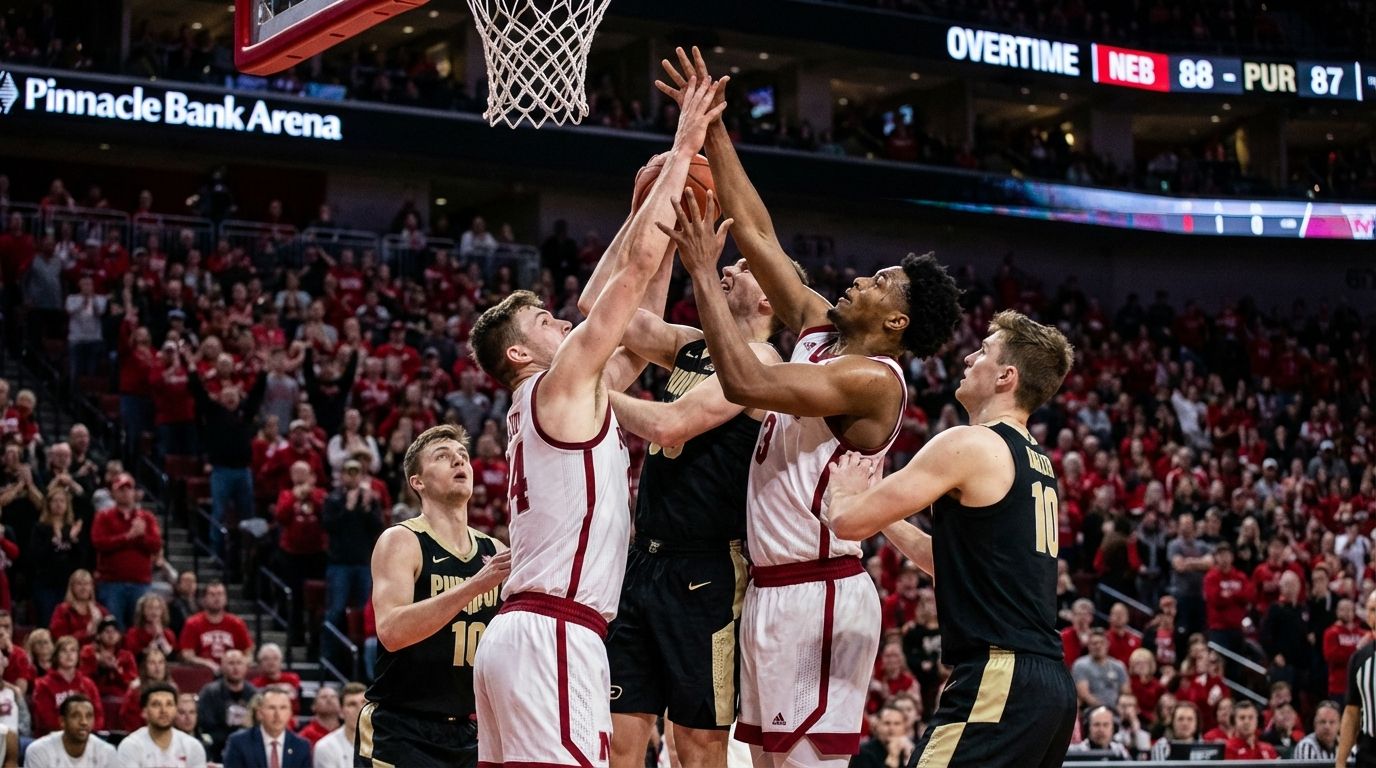
Let’s get this out of the way first: Purdue didn’t so much close out Nebraska as survive them. For 25 minutes in Lincoln, the Boilermakers looked like a top‑five buzzsaw, stretching the lead to 22 behind Braden Smith’s orchestration, Fletcher Loyer’s early heater and a steady diet of second‑chance points. Then they did what this Purdue team loves to do — they drifted, relaxed, and let an opponent all the way back into a game that should’ve been over before the students finished their halftime nachos. Nebraska, half-asleep for the first 10 minutes, woke up with a barrage of threes, a 14–1 closing run in regulation and a home crowd that refused to bail even when the score screamed blowout. By the time overtime tipped, it felt less like a road game and more like a courtroom cross‑examination of Purdue’s toughness.
The verdict, for one night, was that size and persistence still matter in a sport obsessed with spreadsheets and shot charts. Matt Painter went back to his big lineup in OT, and once Rienk Mast fouled out, Nebraska had nothing close to an answer on the glass. Purdue out‑rebounded the Huskers by six in the extra period, lived at the foul line, and finally cashed the winning ticket on a spinning layup by Oscar Cluff with 5.2 seconds left. It’ll go down as an 80–77 road win over the No. 7 team in the country, but context matters: this was also Purdue nearly coughing up a game where they controlled just about every important number for most of the night. If you’re into championship psychology — and not just the paint-by-numbers analytics — this was a fascinating little case study.
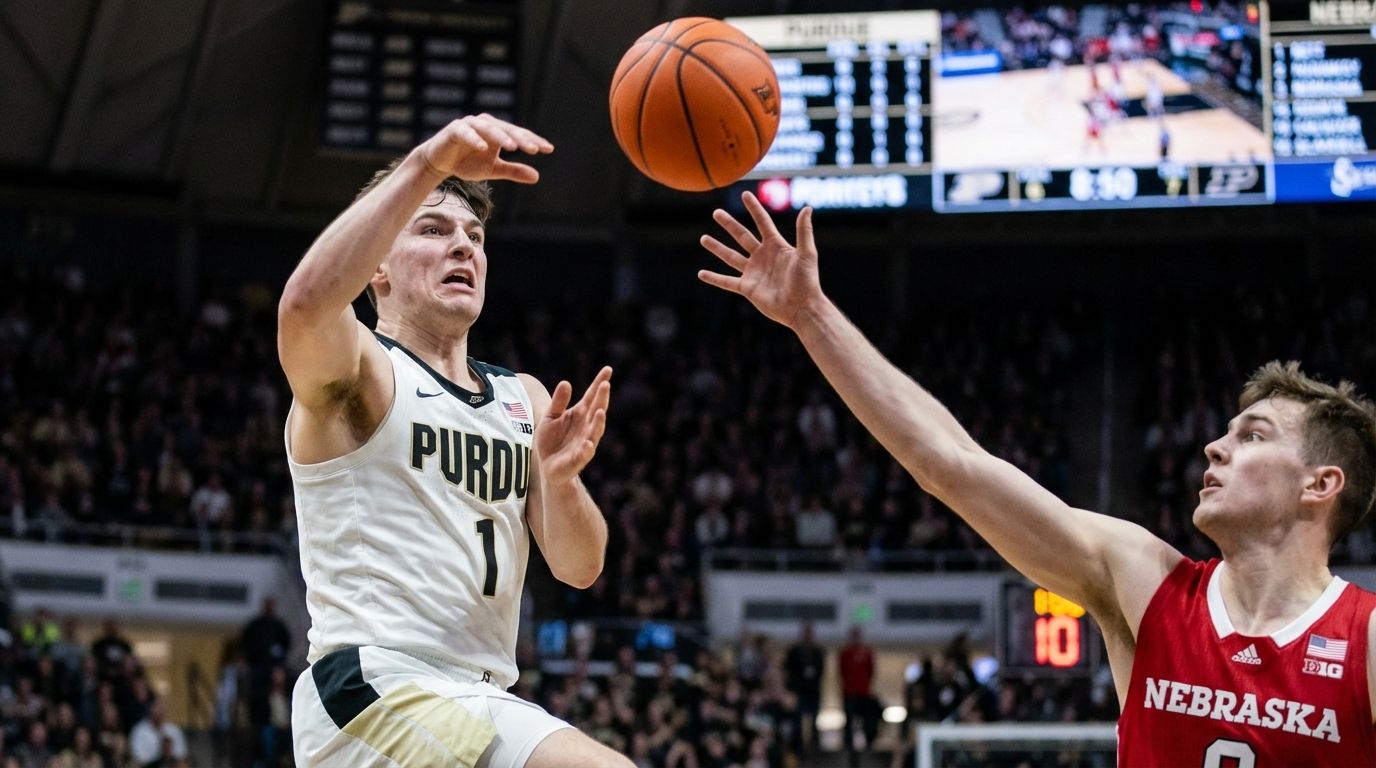
In the Big Ten race, think of Purdue less as a favorite and more as the chaos agent your coach secretly fears. They’re sitting a couple games behind Michigan, tied with Nebraska and Michigan State, and staring down a schedule that includes the Wolverines and Spartans plus the usual rivalry landmine with Indiana. Michigan is still the rational pick to win the league; Dusty May’s group has the record, the efficiency profile and the look of a team that knows exactly who it is. Purdue, meanwhile, is the talented neighbor with the loud parties — maybe they don’t own the block, but they sure can ruin your Saturday night. At 127.1 points per 100 possessions on offense, this is Painter’s most potent unit since he took the job, which means they’re absolutely capable of tripping up Michigan or anyone else if they catch a rhythm.
Of course, “capable of” and “trustworthy” are not the same thing, and the last few weeks are exhibit A. Three losses in a six‑game stretch, a couple of single‑digit squeakers, and long stretches where the focus wanders — that’s how you end up as the team nobody wants to see in March, but also the team nobody’s shocked to see flame out early. From a neutral vantage point, that volatility is terrific entertainment; from the standpoint of a program that just lived through the Zach Edey era without a Final Four, it’s a little more nerve‑racking. You don’t get to hide behind a 7‑foot‑4 safety net anymore. This group has to prove it can win with balance, poise and shotmaking instead of just throwing the ball into a mountain and waiting for gravity to do the rest.
One good omen for Purdue is Fletcher Loyer rediscovering his shot and his swagger. From early January through late in the month, Loyer shot 27.3% from three over a seven‑game slump and looked every bit like a guy carrying that struggle around on his shoulders. The team followed suit, dropping three in a row to Indiana, Illinois and UCLA. Since then, he’s dropped 29 on Maryland, 18 more in a tricky win over Oregon, and now a team‑high 18 in Lincoln, punctuated by a pair of early threes that forced Fred Hoiberg into an “I’ve seen enough” timeout. Over his last three games, Loyer is sitting at 21.7 points per night, and the tape passes the eye test: the fake‑and‑drive, the confident relocation, the willingness to take the big shot are all back.
If you want to talk about “analytics backfiring,” don’t look at KenPom, look at how Nebraska is interpreting the religion of the three‑pointer. Hoiberg’s offense is gorgeous when it’s humming — five shooters, constant movement, the ball flying around the perimeter like a pinball. They came into this one ranked 29th in offensive efficiency and among the nation’s most three‑dependent high‑major teams, getting over 41% of their points from deep. When you’re undefeated, that looks like genius. When you run into Michigan, Illinois and now Purdue, it starts to look like a single‑gear engine.
Against top defenses, that extreme shot profile can trap you. Nebraska made just eight field goals in the first half, only four inside the arc, and spent 20 minutes looking like they were playing an away game in their own paint. By the time they caught fire in the second half — seven of 14 from deep after the break — the margin for error was razor thin. Yes, modern basketball math says threes are worth more than twos; it doesn’t say you’re required to treat the mid‑range and the rim like they’ve been outlawed by some federal agency. The Huskers finished with only 14 makes inside the arc, one more data point for the argument that balance, not extremism, tends to win in March.
On the flip side, this version of Oscar Cluff is exactly the evolutionary step Purdue needed post‑Edey. Painter brought him in out of the portal as a more traditional center body — 6‑11, 255 — who could let Trey Kaufman‑Renn slide to his natural four spot and restore some edge around the rim. After a hot start to the season, Cluff had quietly faded, averaging 5.2 points and 3.8 boards over the five games before the trip to Lincoln. Then he showed up like the guy who put up 17.6 and 12.3 at South Dakota State: 14 rebounds, 10 of them on the offensive glass, plus efficient scoring, rim protection and a little playmaking sprinkled in. If that’s the Cluff Purdue gets the rest of the way, the Boilermakers suddenly have a front line that doesn’t just survive in a post‑Edey world but actually gives them a different — and arguably more versatile — identity.
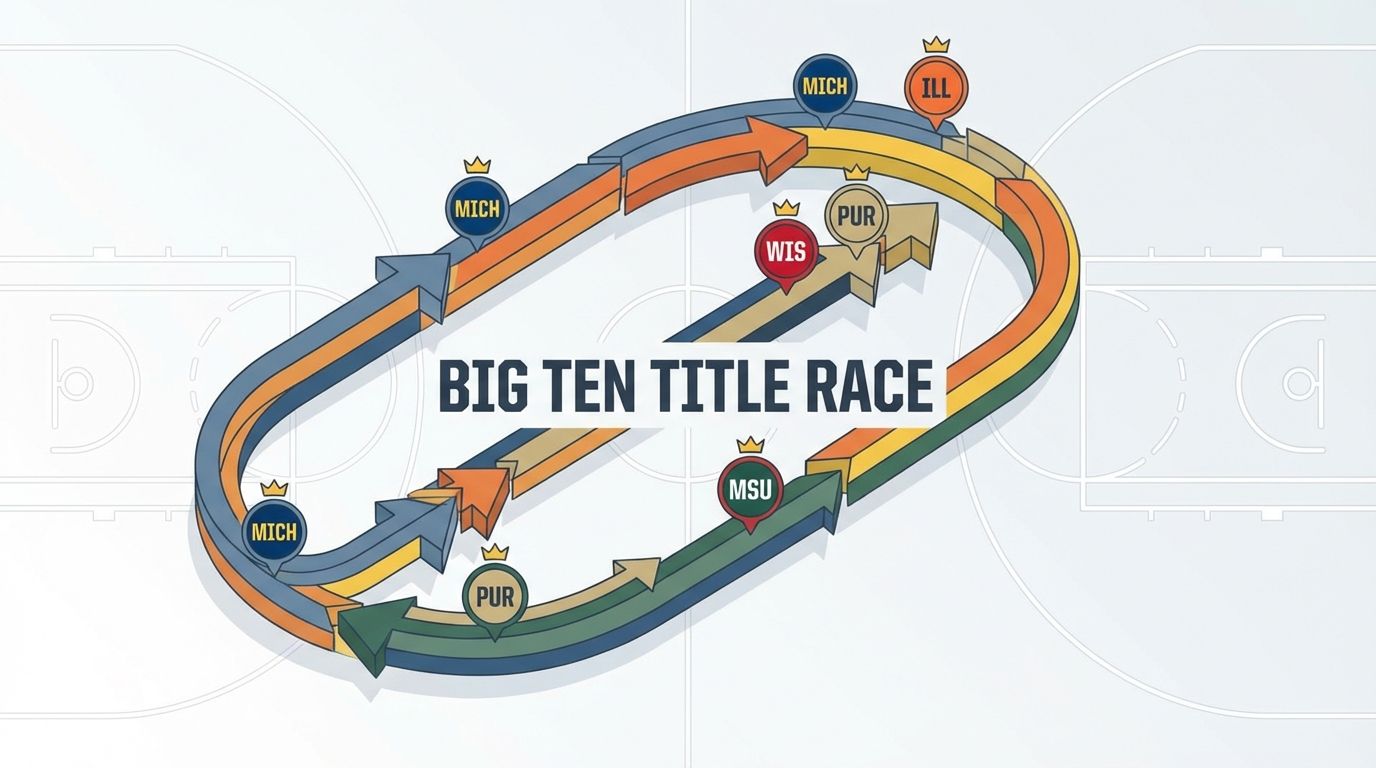
The schedule will stress‑test all of this very quickly. Purdue’s got Iowa on the road, then a three‑game home gauntlet with Michigan, Indiana and Michigan State before a softer landing against Ohio State, Northwestern and Wisconsin. Go 4–2 or better in that stretch and they’re not just a spoiler; they’re back in the title conversation and tracking toward a No. 2 seed with real teeth. Stumble, and they’re the same talented, maddening team we’ve seen for most of February — the one bookmakers respect and fans outside West Lafayette don’t quite buy yet. Nebraska, meanwhile, gets the schedule equivalent of a reset button: no ranked teams on tap, several opponents under .500 in league play, and a path to float into March as the “dangerous shooting team nobody wants to see,” whether that label is actually predictive or just something TV guys say between commercial reads.
Strip away the rankings and the hype and what Tuesday night really showed is how thin the line is between “contender” and “interesting sideshow.” Purdue walked that line for 45 minutes and came out on the right side because they finally leaned into their size and toughness instead of trying to out‑cute a very good shooting team on the road. Nebraska danced on the wrong side, trusting the three so much that they didn’t establish anything easy until desperation kicked in. From a neutral, mildly contrarian chair in Scottsdale, it’s hard not to see this as a microcosm of the sport: everybody wants the shortcut, the perfect model, the one weird trick; in the end, the teams that last are usually the ones willing to do the unsexy work on the glass, on defense and in the paint. For one night, at least, Purdue remembered that in time. Nebraska didn’t.