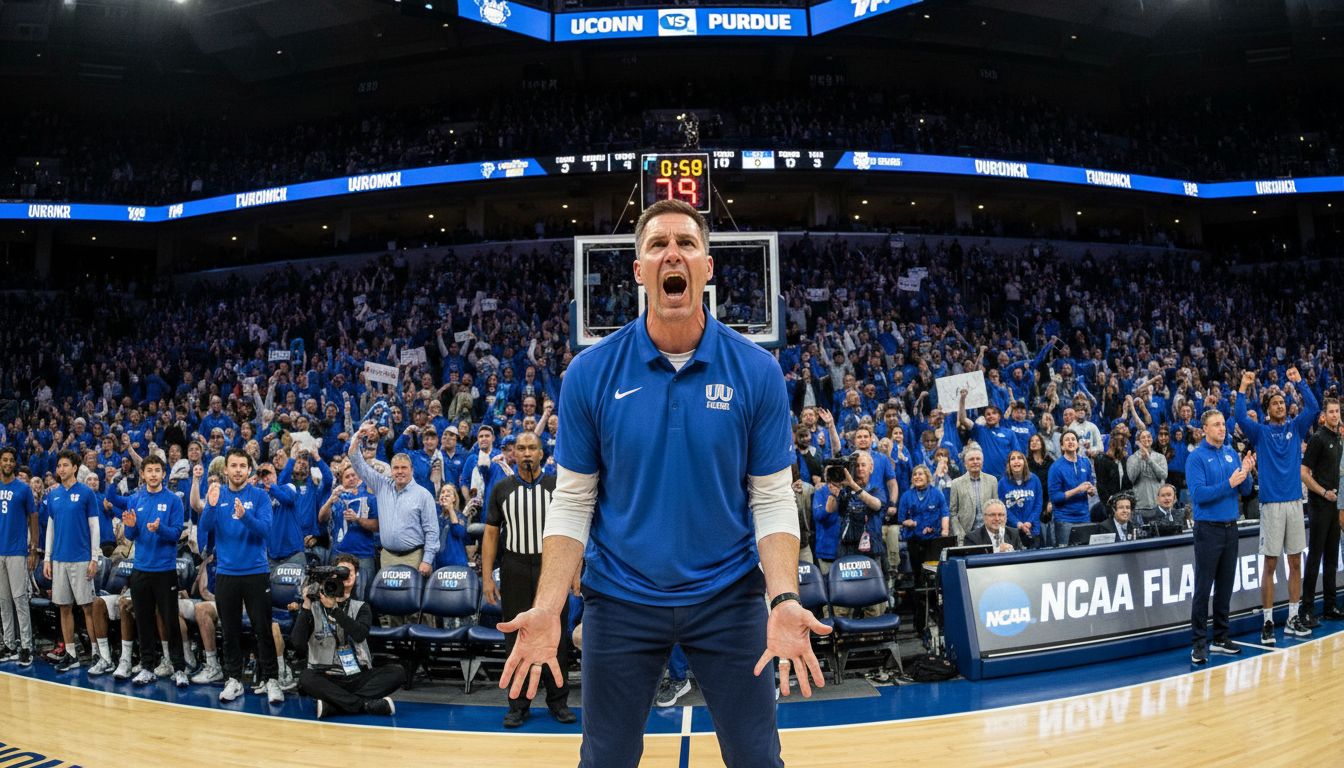
Every March, coaches feed players the same line: lock in on the next game, don’t look ahead, don’t start smelling the Final Four before you’ve even laced up for the Sweet 16. Dan Hurley hears that sermon like everyone else, but he’s not exactly living by it this week. The UConn head coach, already a two-time national champion, has openly acknowledged what a lot of fans and gamblers on the East Coast are already daydreaming about: a potential Elite Eight rematch with St. John’s. For Hurley, the matchup with Michigan State is the business in front of him, but the idea of another shot at Rick Pitino’s group is clearly hovering in the background. This is the tension of March: the need to be ruthlessly present in the moment while also understanding the bigger chessboard that everyone in the sport can see.
Hurley’s public comments are classic him: blunt, a little brash, and very aware of the theater around college basketball. He’s gone as far as calling on UConn and St. John’s fans to hold a brief peace treaty, root for each other on Friday night, then get back to hating each other if both teams advance to face off on Sunday. He even described that hypothetical Elite Eight clash as a "bloodbath," a word that probably makes his sports information staff wince but perfectly captures the emotional temperature between these two Big East powers. From a player’s perspective, that kind of talk is a double-edged sword: it can juice your confidence and give the locker room a shared vision, but it also hands your opponent bulletin-board material if you’re not careful. The reality is, Michigan State and Duke don’t care about Hurley’s wish list; they care about 40 minutes of basketball and sending somebody home.
The bracket dynamics add another twist. On paper, Pitino’s route is tougher: St. John’s has to go through top-seeded Duke, which oddsmakers have as a comfortable favorite, while UConn is only a slight favorite in its matchup with Tom Izzo’s Michigan State. If both Big East teams survive, the arena in Washington could end up sounding more like Madison Square Garden in March than the home of the Wizards and Capitals. Hurley has admitted it "stinks a little bit" that two conference teams might meet in a regional final instead of on the Final Four stage, but that’s the tradeoff when a league is this top-heavy. For the Big East, a UConn-St. John’s showdown in the Elite Eight would be both a bragging-rights brawl and a national advertisement for the conference’s current strength.
The recent history between these two programs explains why Hurley wants another crack at the Red Storm so badly. St. John’s has taken two of three meetings this season, including a 20-point win in the Big East Tournament title game that left no room for excuses. UConn did hand St. John’s its only loss since early January in a February blowout in Storrs, but the larger body of work tilts slightly toward Pitino’s squad. That balance of power has been shifting all season: UConn started off at 22-1, then stumbled to a more human 7-4 close to the regular season before finding its footing again in the tournament. Meanwhile, St. John’s went from 9-5 and searching for itself to a group that looks like it finally understands Pitino’s defensive demands and offensive spacing.
For UConn, this Sweet 16 run has been about re-establishing its identity after last year’s early exit, when the Huskies were bounced in the second round by Florida, who went on to win it all. This time around, they handled business with wins over Furman and UCLA, reminding everybody why the program still sits comfortably near the top of the college basketball hierarchy. Those games also turned into something of a coming-out party on the national stage for Tarris Reed Jr. and a reminder of how important Alex Karaban is to everything UConn wants to be. Reed’s 31 points and 27 rebounds in the opener against Furman were the kind of throwback numbers you usually only see when somebody dusts off old tournament box scores from the 1960s. Karaban then dropped a career-high 27 against UCLA, steadying the offense and showing why veteran wings who have truly grown up inside a single program are still the backbone of championship-level college teams.
Karaban’s story is quietly one of the most interesting subplots in this whole thing. In an era defined by the transfer portal and NIL reshuffling rosters every offseason, he’s a fourth-year senior who has lived his entire college career in one jersey. If UConn can somehow hang another banner, he would join the incredibly small club of modern players with three national titles, putting his name alongside some of the role players who made John Wooden’s UCLA teams so devastating. Inside a locker room, that kind of continuity matters more than any metric: when your best veteran sets the standard and has already walked the road you’re trying to travel, younger guys are far more likely to buy into the daily grind. Guard Braylon Mullins basically said as much, calling Karaban the team’s leader and the one who holds the standard for the program, which is exactly the kind of internal accountability you need when expectations are sky-high.
Depth and health will go a long way in determining whether UConn’s March has another deep chapter. All-Big East guard Silas Demary Jr. returned from an ankle injury to give the Huskies 22 important minutes against UCLA, even if he wasn’t quite at full explosiveness. On the flip side, Jaylin Stewart is still dealing with a knee issue that has kept him out since late February, and every game he misses tightens the rotation just a bit more. Coaches will always preach the "next man up" mantra, but from the player side, those absences shift roles, shot distribution, and emotional load in ways that don’t always show up on the scouting report. If UConn is going to survive Michigan State’s physicality and possibly another war with St. John’s, they’ll need both stars and role players to manage that burden without burning out mentally or physically.
There’s also the mental strain of playing while everyone around you talks about future matchups you may never get to see. Hurley’s willingness to speak openly about a potential St. John’s rematch can be read two ways: either as supreme confidence that his group can handle the noise, or as a risk that invites distraction at the exact wrong time. In reality, most players already know what the bracket looks like; phones, group chats, and social media make it impossible to fully shield a locker room from the outside world. The best programs don’t pretend the talk isn’t happening, they just find ways to channel it, using a possible showdown as fuel while still respecting the opponent that’s actually in front of them. That balance is where coaching, leadership, and player empowerment intersect: athletes need the space to own their ambitions out loud, but also the discipline to put those ambitions on hold for 40 minutes at a time.
From a broader lens, this moment is a snapshot of modern college basketball’s contradictions. You’ve got a traditional power in UConn trying to extend a championship window in an era when rosters flip almost yearly, and a resurgent brand name in St. John’s rebuilding its edge under one of the game’s most polarizing coaches. You’ve got a Big East that’s fighting to prove it can still stand shoulder to shoulder with the Big Ten and SEC in March, and a bracket that might force two of its best to knock each other out before the Final Four lights even come on. And threading through it all is the human reality: players dealing with expectations, injuries, social media crossfire, and the knowledge that a single cold shooting night can erase months of work. Whether or not we get the "bloodbath" Hurley is craving, we’re already seeing why March has a way of revealing which programs truly understand that fine line between confidence and distraction.