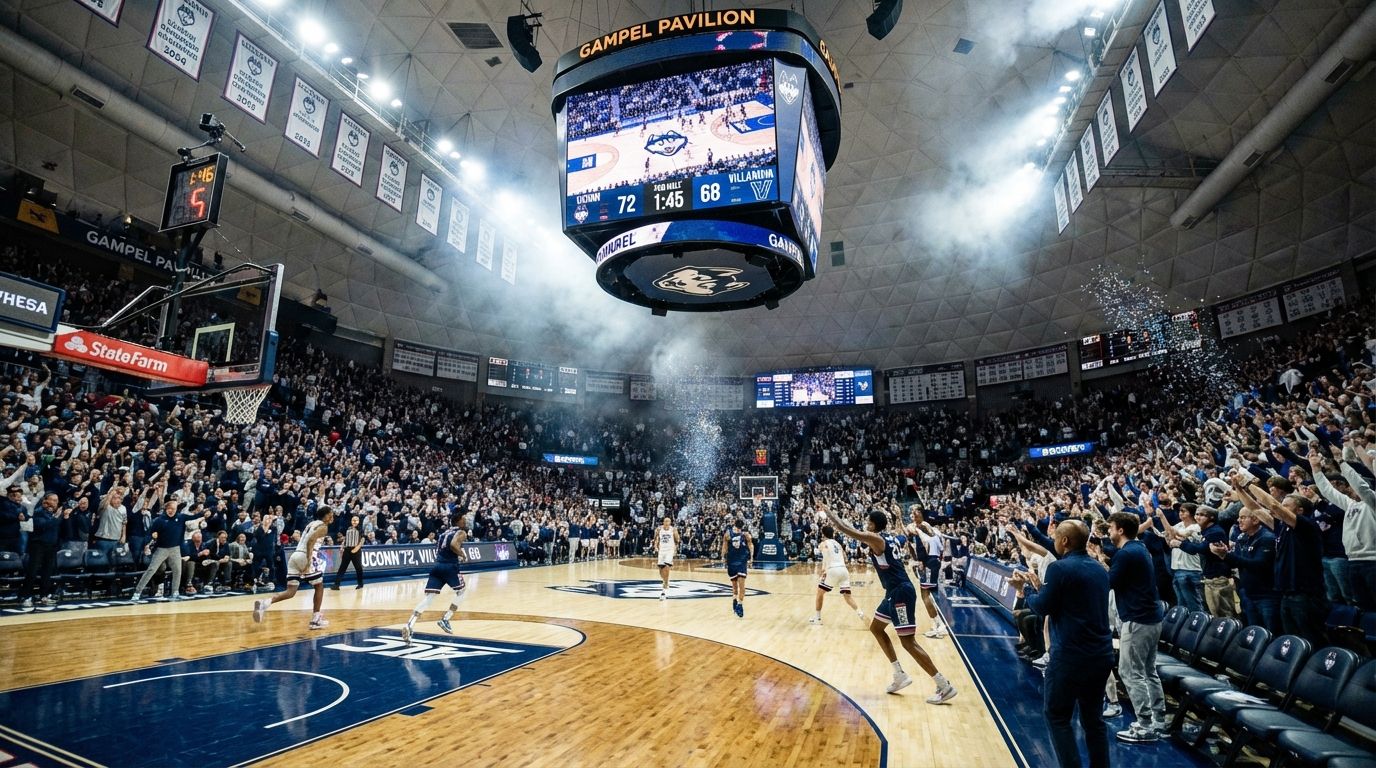
The betting line on Saturday’s Villanova–UConn game looks, on its face, like just another number on just another app: Huskies by 10.5, total at 136.5, money line tilted heavily toward the second‑ranked team in the country. It’s the sort of thing most fans glance at, maybe tap once or twice, and move on. But lines don’t appear by magic, and neither do the models and promo codes aggressively wrapped around them. Behind this one regular‑season Big East matchup sits a dense web of algorithms, sportsbooks, media partners, and incentives, all converging on a game still played by nominally “amateur” athletes. If you care about accountability in sports, you can’t afford to treat that web as background noise anymore.
Start with the basics of the matchup itself. UConn comes in 18‑1 overall and 8‑0 in the Big East, riding a 14‑game winning streak and a 9‑1 mark on its home floor. Villanova, at 15‑4 and 6‑2 in conference, has been solid but winless in two tries against ranked opponents this season. Historically, Villanova holds a narrow 40‑38 edge in the series, but UConn has seized control lately, winning six of the last seven meetings. On paper, and frankly on hardwood, the Huskies deserve to be favored; there’s nothing inherently sinister about that.
What deserves more scrutiny is the way this game is packaged for the public. The article pushing this matchup isn’t just previewing basketball; it’s an extended sales funnel for sportsbooks and betting apps, anchored by a proprietary projection model that simulates the game 10,000 times. The model is described as “sizzling,” boasting a 10‑1 run on top‑rated over/under picks dating back to last season, language that walks right up to the edge of promising outcomes without crossing the regulatory line of guaranteeing returns. Then, almost on cue, come the promo codes: bet $5, get $300 in bonus bets here; place $5, get $200 there. The actual basketball—Bryce Lindsay projected at 14.3 points, Alex Karaban at 16.7, five players in double figures on each side, the model’s total of 148 points—starts to feel like seasoning on the main dish, which is acquisition of new bettors.

There’s nothing illegal about any of this, to be clear, but legality and accountability are not the same thing. College sports lives in a gray zone: the NCAA has spent decades preaching amateurism while quietly tolerating, and now openly integrating, massive commercial interests around players who only recently gained the right to earn anything close to market value through name, image and likeness deals. Yet the ecosystem around Saturday’s game is awash in real money flowing to sportsbooks, media outlets, data vendors, and universities through sponsorships—while the athletes themselves remain the least protected actors in the entire structure. We are told, reassuringly, that the projection model “simulates every college basketball game 10,000 times,” as if scale alone is virtue. It’s a useful tool if you’re disciplined, but it’s also a powerful marketing instrument in a landscape where very little of the revenue is subject to meaningful independent oversight.
The specifics of the model’s pick—leaning Over 136.5 with a projected total of 148, noting that the Over has hit in five of Villanova’s last six games and in three of UConn’s last six—are less interesting than the pattern of presentation. We’re invited to believe in the algorithm’s authority, yet the most important recommendation is hidden behind a paywalled service: “You can only see that pick at SportsLine.” In other words, trust the model enough to bet, but pay first to be told exactly how. That’s one step removed from selling certainty, and it lands especially awkwardly in a college environment where the line between data analysis and exploitation is getting thinner by the televised week. When you build an economic engine around “coveted picks,” you’re not just covering a game; you’re monetizing the psychology of fans who feel outgunned by the house and are desperate for an edge.
None of this means fans should swear off betting or that models are inherently corrupt; tools are tools. But the current arrangement leaves serious questions hanging in the air. What disclosure do bettors have about how these models are built, tested, and audited? Who checks whether the promotional language around “10‑1 runs” and “strong returns” reflects long‑term, replicable performance rather than hand‑picked hot streaks? And at the institutional level, how are conferences and universities accounting for the reputational and integrity risks when their games become the raw material for an aggressively monetized prediction industry that sits just inches from the court?

The players most directly implicated in these numbers—Lindsay, Karaban, and their teammates projected to hit certain scoring marks—have no real voice in how their likenesses and statistical profiles are used to drive betting content. Their performances are parsed into over/unders, parlays, and same‑game specials that serve everyone’s balance sheet but theirs. Yes, NIL has opened some doors, but the dark money sloshing around that space often flows through the same intermediaries—agents, boosters, offshore operators—that thrive in low‑transparency environments. When projection models and bonus‑bet offers are tied so tightly to individual college athletes, the need for clear guardrails becomes more than an academic ethics question; it becomes a basic labor‑rights issue.
For fans, the first step toward accountability is refusing to be passive consumers of this ecosystem. If you’re going to bet the Over because a model that “simulates 10,000 times” says the combined score will hit 148, ask what time frame those touted records cover and how many cold streaks aren’t being advertised. If you’re enticed by a $300 bonus on a $5 bet, read the terms and think about why a company can afford to give away that much in the first place. A little skepticism is not cynicism; it’s self‑defense. College basketball can be thrilling on its own merits, but once money enters the bloodstream, everyone involved has an obligation to show their work.
UConn may very well cover the 10.5, Villanova may keep it close, the Over may cash easily, or the game could grind into a defensive slugfest that makes every bettor on either side miserable. That uncertainty is the honest part of sports and the only reason any of this is interesting in the first place. What’s less honest is pretending that the growing infrastructure of betting content around college games is neutral or inevitable. It’s the product of choices by leagues, schools, media companies, and regulators who decided that this is where the money is. If we’re going to lean on models to tell us what’s “likely” on the court, we should be just as relentless in demanding transparency about what’s happening off it.