
Every February, basketball slips into its favorite costume: spectacle masquerading as serious competition. The NBA’s latest All-Star experiment — three teams in a mini “USA vs. the World” tournament — isn’t just a gimmick; it’s an admission that the sport is now decisively global, even if the branding still clings to borders. College basketball, supposedly the bastion of “amateurism” and national pipelines, has already been living in that future. If you pay attention to rosters instead of just jerseys, you’ll notice something obvious: the American college game has quietly become an international commons. So let’s linger there for a moment and imagine a college version of USA vs. the World — not as a jingoistic showdown, but as a snapshot of how borders blur once the ball goes up.
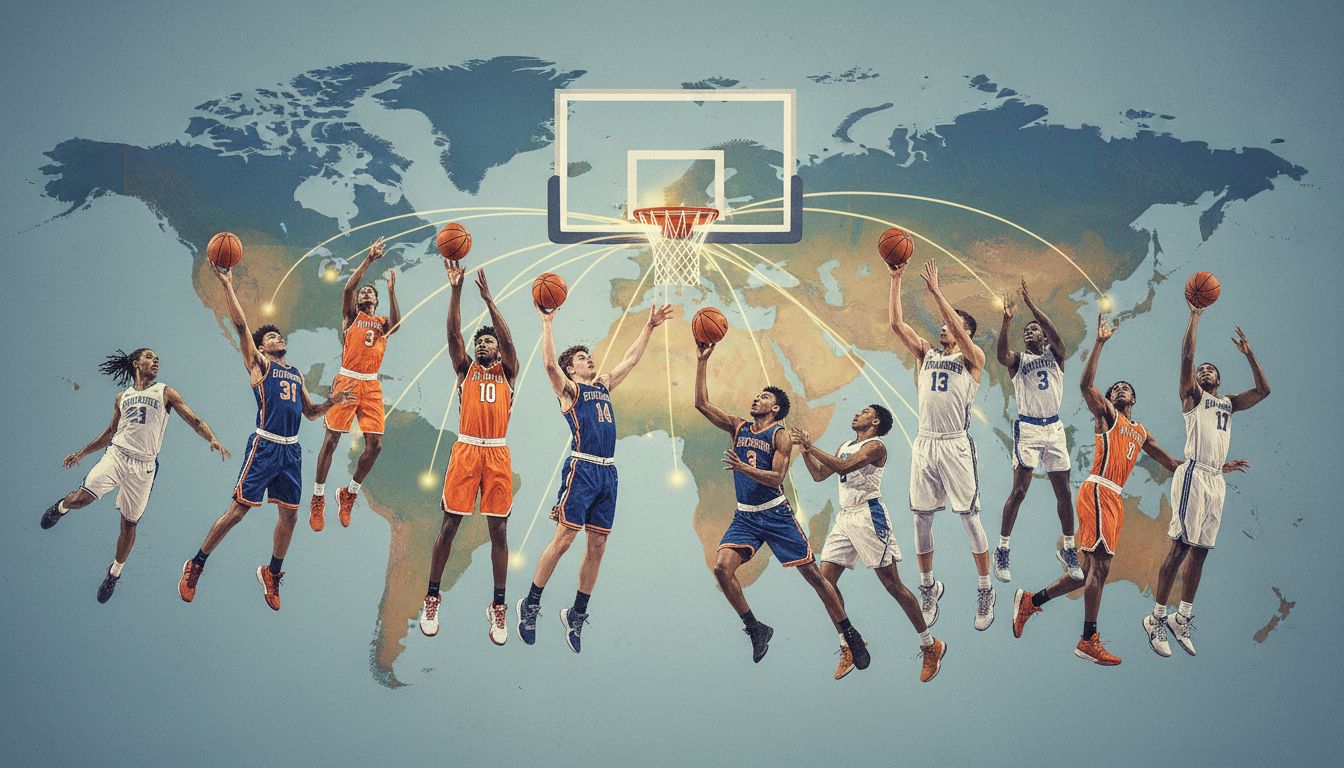
Start with Team World, because that’s where the story is most honest about what basketball has become. Take Christian Anderson at Texas Tech, running an offense with German precision and Big 12 audacity, fresh off a silver medal run with Germany’s U19 squad. Or AJ Dybantsa at BYU, Boston-born but carrying Jamaica with him — not as a marketing flag, but through family, language, and a hurricane relief effort that looks suspiciously like genuine responsibility, not brand management. Nate Ament at Tennessee moves seamlessly between lighting up SEC defenses and organizing a camp in Rwanda, as if high-usage wing and community organizer were just two line items on the same scouting report. Yaxel Lendeborg at Michigan and Zuby Ejiofor at St. John’s, both tethered deeply to the Dominican Republic and Nigeria respectively, remind us that “eligibility” cuts one way on the court and another way entirely when you’re talking about passports, parents, and who you’re really playing for.
On this imaginary Team World, the reserve unit is almost perversely stacked, a reminder that the word “import” has lost any useful meaning in basketball. You have Aden Holloway at Alabama, repping Canada through his mother’s roots while torching SEC defenses from the three-point line. Thijs De Ridder at Virginia, a Belgian forward who looks like the prototype for the modern European wing, has turned a traditionally defensive program into an ACC contender through efficiency and spacing. From Nigeria to Australia to the Democratic Republic of Congo and Estonia, the depth chart reads like a world atlas: Rueben Chinyelu anchoring Florida’s interior, Alex Condon extending possessions and possibilities in Gainesville, Flory Bidunga keeping Kansas relevant through turbulence, and Henri Veesaar stretching the floor for North Carolina in the biggest moments. Chad Baker-Mazara at USC and alternates such as Baylor’s Tounde Yessoufou and Nebraska’s Rienk Mast underline the real point: you don’t need to squint to see an international all-star team in college hoops anymore. You just need to actually read the rosters instead of the recruiting rankings.

Of course, the USA side isn’t exactly short on drama or talent either; it never is. You could build a perfectly terrifying core around Kingston Flemings at Houston, Darryn Peterson at Kansas, Caleb Wilson at North Carolina, Cameron Boozer at Duke, and Joshua Jefferson at Iowa State. This group isn’t just a collection of scorers with shiny box scores — though the numbers are frankly absurd, from Boozer’s 23 and 10 to Peterson’s blistering shooting splits. They are, in classic American fashion, branded as the next wave of inevitable stars: Wooden candidates, draft darlings, rivalry killers, the engines of television packages and tournament narratives. If Team World’s story is about dispersion, migration, and multiple homes, Team USA’s is framed — by media, at least — as lineage: who follows whom, who surpasses which previous freshman phenom, and which blueblood gets to hang another banner.
The bench for Team USA reads like a committee report on American basketball excess. Purdue’s Braden Smith threads passes through impossible windows and still somehow finds time to chase national assist titles. Darius Acuff Jr. at Arkansas fits neatly into the John Calipari tradition of ball-dominant guards who turn systems into platforms and platforms into draft capital. Keyshawn Hall is essentially Auburn’s offensive oxygen, while Keaton Wagler has stepped into a starring role at Illinois without waiting for seniority. Milan Momcilovic lasers threes at a rate that makes the midrange feel like a moral failing, Thomas Haugh’s bet on himself at Florida appears to be paying off, and JT Toppin has quietly climbed from overlooked recruit to double-double machine at Texas Tech. By the time you mention Labaron Philon Jr. at Alabama and alternates like Gonzaga’s Graham Ike and UConn’s steady Alex Karaban, you’ve left realism far behind and entered the realm of thought experiment — which, to be fair, is exactly where an exercise like this belongs.

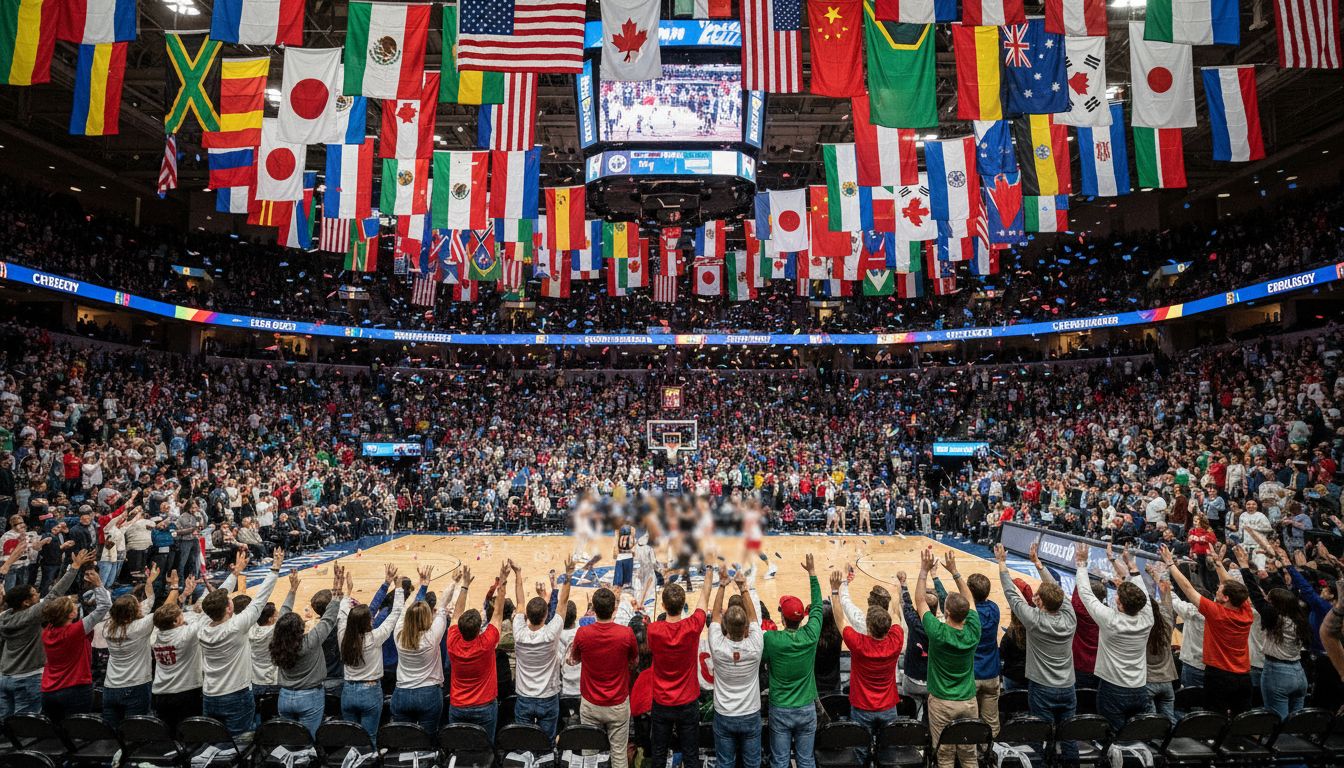
The obvious question, the one the fantasy matchup invites, is simple: who would win, USA or World? The honest answer is that it doesn’t actually matter, and the insistence on resolving that question is more revealing than any hypothetical box score. Framing this as “USA vs. the World” presumes a clean division that doesn’t exist in the lives of these players, many of whom straddle dual citizenships, split childhoods, and hybrid identities. Christian Anderson isn’t less German because he plays in Lubbock, and AJ Dybantsa doesn’t become less Jamaican because he wore USA on his chest at youth tournaments. The binary collapses under even mild scrutiny; what we really have is a world vs. itself, rendered in zone coverages and transition sets.
There’s also a more uncomfortable layer here, one that tends to get sanitized out of glossy all-star spreads. College programs and their media ecosystems are unashamed about treating international pipelines as markets, even as they dress it up in the language of “opportunity” and “global growth.” When a player like Flory Bidunga holds Kansas together through injuries and adversity, he’s both a campus hero and part of a recruiting logic that views regions of Africa as the next undervalued asset pool. The same is true in subtler ways with European and Caribbean prospects, whose stories are often reduced to “raw upside” and “high motor,” as if they floated into the gym on a demographic trend line instead of years of underfunded local work. To acknowledge the brilliance of this imaginary World roster without also naming the extractive logic that underpins parts of the system would be, frankly, dishonest.
And yet, if you listen closely to the players’ own choices, you hear something gentler and more defiant than market logic alone. Dybantsa organizing relief after a hurricane in Jamaica, Ament building a camp in Rwanda, Okorie’s nonprofit work in Nigeria — these are not just résumé items; they are refusals to let basketball sever roots in the name of upward mobility. Even the Americans in this exercise complicate the straightforward “home vs. abroad” frame: they move through AAU circuits, prep schools, and transfer portals that are their own kind of border crossing, where labor is monetized long before anyone calls it labor. You don’t need to romanticize any of this; you just have to admit that the players are doing more than filling out marketing categories. They are, in ways small and large, insisting that the game move with them, not the other way round.
So what do we do with this little thought experiment, besides argue about hypothetical spreads and matchups online? One answer is boring but necessary: we could demand that institutions — from the NCAA to the schools themselves — treat this obviously global ecosystem with the seriousness it deserves, whether that means supporting national team commitments, improving support for international students, or being transparent about how and why certain “pipelines” are cultivated. Another answer is more personal: as fans, we can choose to see players as more than placeholders in mock drafts or convenient avatars of national pride. Cheering for Team USA or Team World is fine; insisting that either side be pure, uncomplicated, or neatly owned by one flag is just lazy thinking. The beauty of this moment in college basketball is that the court is crowded with players whose lives ignore the lines on the map even more thoroughly than they ignore defenders in the lane. If we’re going to celebrate that on All-Star weekend, we might as well learn how to see it clearly in the college game the rest of the year too.