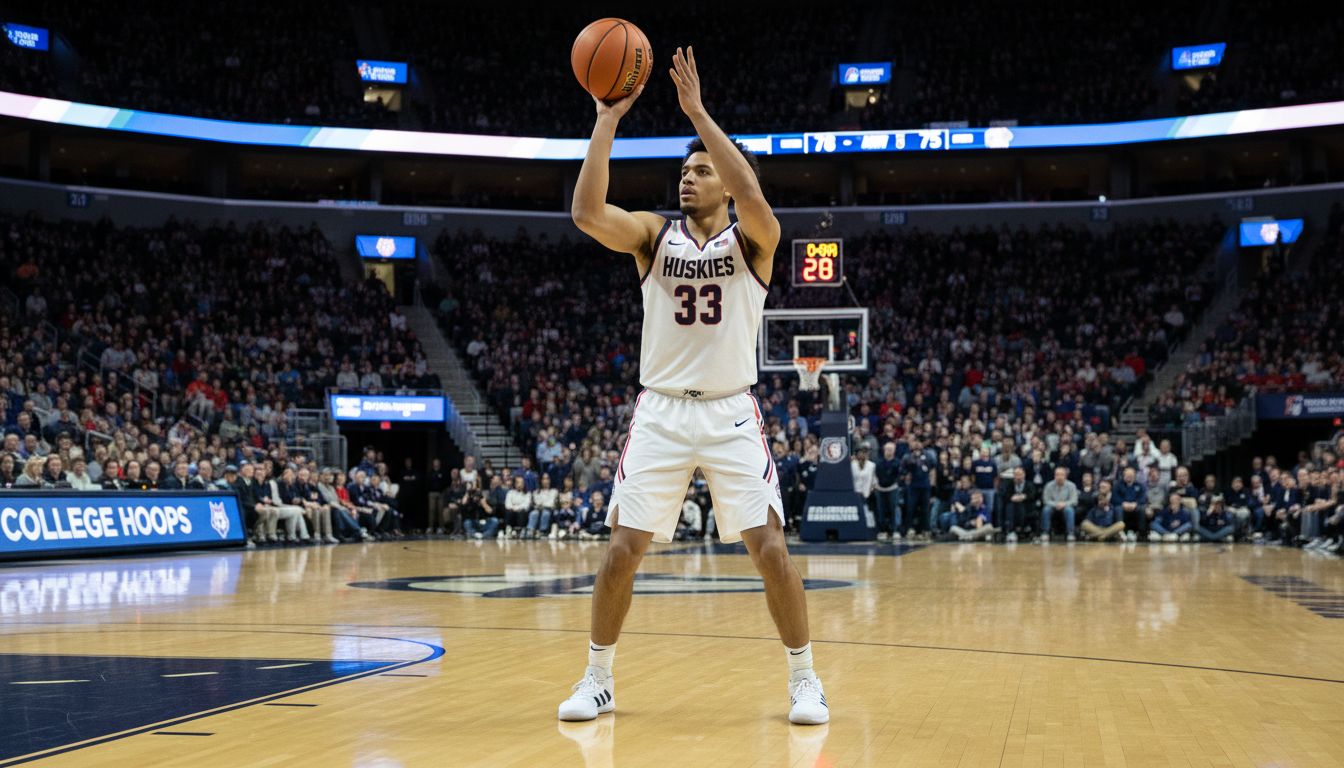
If you only skim box scores in March, Alex Karaban looks like a nice, efficient stretch forward on a very good team, the kind of player NBA scouts file under "solid" and move on from. That’s a category error. What UConn actually has in its redshirt senior is a fifth-year metronome who has already started two national-title runs and is now trying to anchor a third, this time as the emotional baseline of a roster dealing with rare failure. After a stumble in the regular-season finale against Marquette and a blowout loss to St. John’s in the Big East Tournament title game, UConn slid into the NCAA Tournament as a 29-5, No. 2 seed that suddenly feels—by blue-blood standards—doubtful and doubted. Karaban, characteristically, seems unbothered by the external volatility and far more interested in the simple math of the next 40 minutes.
Asked how he feels heading into what he knows is his final March Madness, Karaban’s answer is almost disturbingly calm: "I feel no pressure whatsoever." He doesn’t duck the failures; he lists them. UConn was picked to win the Big East regular season, it didn’t. The Huskies had a chance to win the conference tournament, they got "walloped." In a media environment that usually tries to spin those facts into elaborate redemption arcs, Karaban’s framing is refreshingly linear: we had chances, we didn’t execute, now people don’t believe in us, and that disbelief is just information—not destiny.
From a data perspective, it’s useful to separate narrative gravity from actual probability. UConn not winning the league or the Big East Tournament shifts the story, but it doesn’t necessarily shift the team’s underlying ceiling. Karaban knows this because he lived the counterexample: in 2022–23, UConn also missed out on the conference tournament crown and then ripped through the NCAA field to a national title by simply stacking six good games in a row. He keeps returning to that principle: one game at a time, no bracket-gazing, no mythologizing momentum. In quant-speak, that’s just refusing to contaminate one sample with the prior—each matchup is its own problem set.
Internally, the mood sounds less fragile than the last week of scores might suggest. Karaban admits the locker room had to "flush" the St. John’s loss, but he’s already mentally back in the lab, talking about Furman as the only object of attention. He’s seen how quickly a team can toggle from disappointment to dominance when the focus tightens. The Huskies lean on familiar pillars: trust in the coaching staff’s prep work, a defensive identity that travels, and an offense that requires an uncomfortable amount of processing from opponents on short notice. If anything, the recent losses might function as a market correction—knocking down the external hype without materially changing the team’s internal belief.
One of the most interesting parts of Karaban’s perspective is how much credit he gives to UConn’s staff for the way they compress information during the tournament. Assistant coaches own individual scouting reports, Hurley layers his voice on top, and players show up to each game feeling, in Karaban’s words, "more than prepared." That level of pregame clarity matters even more in March, when quick turnarounds force teams to solve new offensive structures in about 36 hours. It’s here that UConn’s scheme becomes a kind of competitive puzzle weapon: endless off-ball movement, counters stacked on top of counters, and far more complexity than the typical ball-screen-heavy college offense. Give a staff one practice and a film session to decode that, and you’ve essentially created a cognitive tax that many defenses aren’t built to pay.
Karaban argues that UConn might be "the team that uses the most off-ball movement" in the country, which, while impossible to verify precisely without player-tracking data, certainly passes the eye test. Most defenses are habituated to guarding one or two primary actions—high ball screens, simple pin-downs, basic dribble-drive spacing. UConn, by design, forces you to defend a sequence instead of an action: if you overplay one option, there’s a counter; if you switch here, they slip there. It’s the basketball equivalent of a long, nested if-else statement, and in a one-day prep environment, any mental lag often translates directly into layups and open threes. For a high-feel forward like Karaban, who lives in the spaces this system generates, March isn’t just a pressure cooker; it’s an optimization problem.
Non-conference scheduling is another area where UConn treated the season like a long-term experiment rather than a branding exercise. Karaban points to games against Arizona, Kansas, and BYU—elite, stylistically varied opponents that stress-test your schemes and your habits. The goal isn’t to win a November headline; it’s to generate high-quality reps against tournament-caliber systems so that, by March, there’s very little you haven’t seen. Those games function like noisy but useful training data, building a belief system grounded not in slogans but in lived matchups. When Karaban says, "We felt like we had the best non-conference to prepare us for moments like March Madness," he’s basically describing an intentional sample design.
For all the scheme talk, though, Karaban keeps circling back to intangibles that actually have pretty tangible on-court manifestations. When UConn is at its best, he says, they’re loose but locked in—sharing the ball, talking constantly, defending with real buy-in, and playing with visible joy. That emotional state isn’t magic; it usually shows up in the numbers as low turnover rates, high assist percentages, and opponents stuck in the low 60s. Karaban’s job as a fifth-year anchor is to help the group re-enter that mode, particularly for teammates who have never navigated the NCAA Tournament before. His message to them is balanced: every team in the field is good enough to beat you, so you owe them full respect—but if you forget to enjoy the moment, you’re wasting the childhood dream you finally cashed in.
There’s a temptation, with players like Karaban, to reduce them to archetypes: the steady veteran, the "glue guy," the experienced winner chasing a last ring. Those labels are tidy, but they obscure what actually makes him valuable in March: his willingness to treat the tournament not as destiny theatre but as a six-step problem-solving exercise. He doesn’t posture about pressure, doesn’t romanticize doubt, and doesn’t pretend belief alone wins games. He leans on structure—their offense, their scouting, their schedule—and on relationships inside the locker room that let players hold each other accountable without splintering under stress. If UConn does make another deep run, it will look less like fate and more like a series of rational decisions made well under time constraints, with Karaban quietly optimizing possessions on the back line of all that motion.
If you’re hunting for a neat narrative, you’ll find plenty elsewhere in this bracket: under-seeded darlings, blue-blood revivals, coaching swan songs. Karaban’s "last dance" isn’t really built for that kind of packaging. It’s closer to a controlled experiment: same program, similar stakes, slightly different roster, new data incoming. The Huskies enter as a No. 2 seed with public doubt and internal confidence, a combination that tends to produce more signal than noise once the ball goes up. Whether they exit in the first weekend or cut down nets again, Karaban’s approach offers a useful way to watch March: pay less attention to the storylines we invent and more to the decisions, possessions, and adjustments that actually decide who survives six games.