If you survived the first 48 hours of the 2026 men’s tournament without your bracket spontaneously combusting, you can thank math as much as luck. Friday’s action delivered something we almost never see: favorites went 16-0 straight up, the first perfect chalk day in the opening round since 1992, and they even went 12-4 against the spread. For a sport that loves the word “madness,” we just watched something closer to orderly regression: the market was largely right, the top lines on your bracket mostly advanced, and the models looked pretty comfortable. That sets up a second round that, on paper, is more about sizing edges than hunting miracles. So let’s walk the board, not with hot takes about momentum, but with what the odds and ESPN’s Basketball Power Index (BPI) actually imply.
Start with the top lines: Michigan, Duke, Florida and Arizona all enter the weekend as double-digit favorites, and BPI backs up the sportsbooks’ confidence. Michigan is laying -12.5 to Saint Louis with an 83% BPI win probability and a projected margin of +10; that gap between spread and model suggests the market may be charging a small premium for the Wolverines’ gaudy 31-2 record. Duke is -11.5 against TCU but projects even stronger by the numbers, with BPI making the Blue Devils 14.5 points better and giving them a 91% chance to advance despite their sluggish opener versus Siena. Florida (-10.5 vs. Iowa, 79% BPI) and Arizona (-11.5 vs. Utah State, 83% BPI) profile similarly: heavy favorites whose underlying efficiency has matched their records most of the season. If you’re looking for the most stable part of your bracket, it’s these No. 1 seeds; variance exists, but the math says you’re swimming upstream if you build your strategy around all-out chaos at the very top.

The more interesting questions live in the space between public perception and probabilistic reality, especially in the 3- to 7-seed range where narrative tends to outrun the math. Take Michigan State versus Louisville: the Spartans are -4.5 on the spread, but BPI actually leans ever so slightly to Louisville by 0.2 points and calls the game essentially a coin flip at 51% for the Cardinals. That’s a textbook example of what I’d call a “brand tax” — the extra half-point or more the market tacks on for long-term public trust in a program like Michigan State. St. John’s is another quasi-favorite the numbers treat more cautiously: -3.5 against Kansas with just a 57% BPI edge and a modest +1.8-point projection, far closer than the spread might make it feel. When you see a spread implying something like 60–65% and a model clustering closer to 55–58%, you’re not staring at a lock, you’re staring at noise — and for disciplined bettors, noise is where you find value.
Then there are the true coin-flip games, the matchups that look like they were designed by a statistician with a sense of humor. Vanderbilt is -1.5 over Nebraska in a game BPI pegs at Commodores by 0.8 points and a 53% straight-up edge; Tennessee is a slight -1.5 favorite over Virginia with BPI giving them 61%, which is small enough that one cold shooting stretch flips the outcome. Texas Tech and Alabama is basically a pick’em dressed up as a line: Alabama -1.5, with BPI at just +1.1 Crimson Tide and 54% to advance. Even Michigan State-Louisville, for all the Spartans’ public cachet, lives in this neighborhood by projection. For fans, these games feel like “who wants it more” tests; for those of us who have made peace with randomness, they’re essentially weighted coin tosses played out in front of 20,000 people and a national TV audience.
Double-digit seeds always get cast as Cinderella, but the numbers are refreshingly indifferent to glass slippers. High Point’s upset of Wisconsin was the headline from Thursday, and the Panthers now draw Arkansas as +11.5 dogs with a BPI projection of Razorbacks by 8.2 and a 79% win probability for the 4-seed. That 3.3-point gap between line and model is subtle but notable; it hints that the market may still be baking in some emotional carryover from High Point’s first-round splash while BPI quietly drags expectations back toward their full-season baseline. Texas A&M (+10.5 vs. Houston, 81% BPI to the Cougars) and VCU (+11.5 vs. Illinois, 82% BPI to the Illini) are in similar territory where the real question isn’t “can they win?” but “how often do they keep this inside single digits?”. If you’re filling out a second-chance bracket, sprinkling one or two of these double-digit seeds into the Sweet 16 is defensible, but building your entire tree on upsets that the model prices at 20% or less is less bracket wizardry and more math denial.
Some of the most emotionally loaded matchups come from brands that casual fans know far better than their underlying efficiency. Kentucky versus Iowa State is a perfect case: Kentucky is the 7-seed but still commands public attention, while Iowa State is -4.5 on the board and a 71% favorite by BPI with a projected margin of 5.5 points. UCLA-UConn has a similar vibe, with UConn -4.5 and carrying a 67% BPI edge despite both teams’ strong records and big-conference profiles. Miami-Purdue is slightly more straightforward, with Purdue -7.5 and 78% to advance by BPI, but it fits the same pattern: the market and models agree that the better team over 30-plus games is usually the better bet over 40 minutes, narrative about “tournament pedigree” notwithstanding. The temptation every March is to let past Final Fours and famous jerseys hijack your prior; the healthier approach is to treat those as costumes wrapped around tempo, shooting, and defensive efficiency.
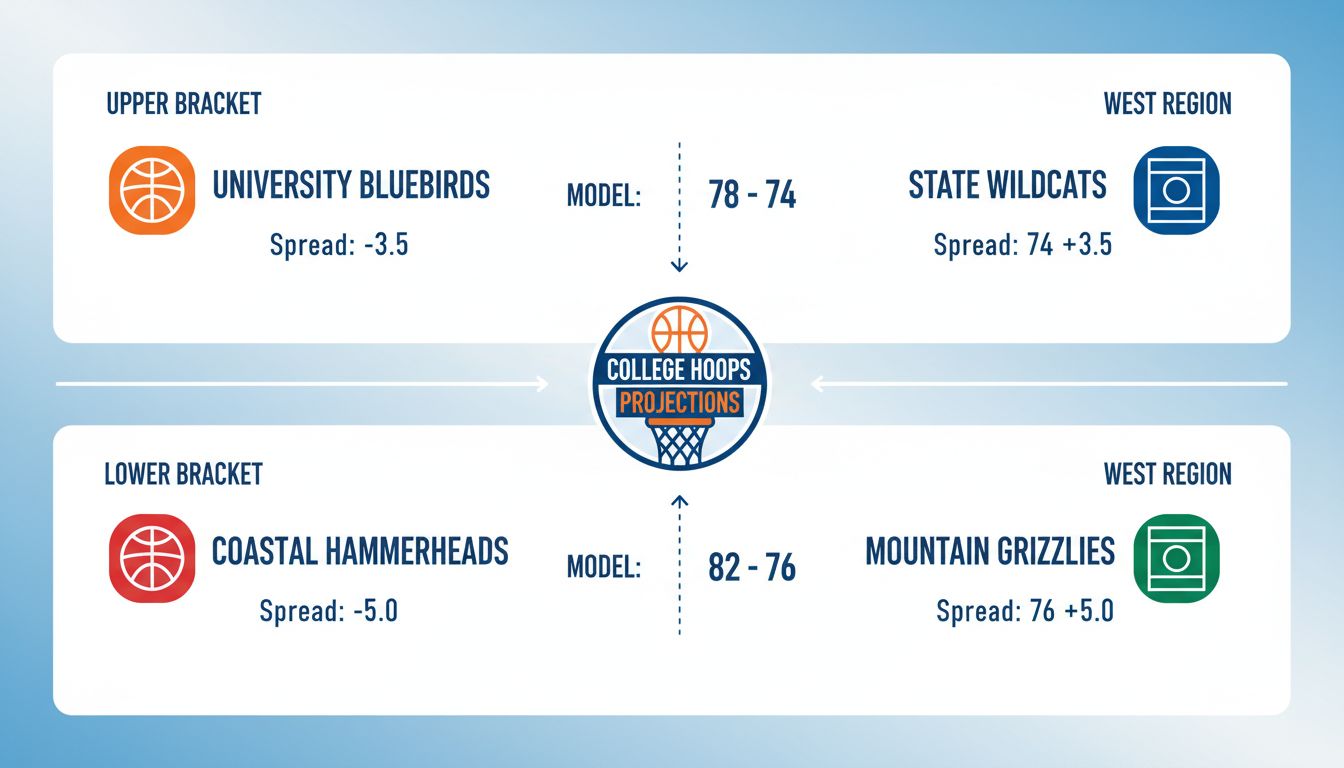
Underneath all of this sits BPI, which is trying to do something aesthetically boring but strategically useful: describe how many points above or below average each team really is, after adjusting for opponent strength, pace, travel, altitude and the rest of the context we’d forget to include on our own. Those ratings feed into game-level predictions that simulate the season 10,000 times, giving us win probabilities rather than binary outcomes and helping separate what’s plausible from what’s probable. This doesn’t mean BPI is an oracle; like any model, it’s only as good as its inputs and assumptions, and it will happily be wrong in individual games while being right in aggregate. But it does offer a reproducible, transparent counterweight to the stories we like to tell ourselves about “teams of destiny” and “clutch DNA,” concepts that tend to dissolve as soon as you measure them carefully over enough possessions. If your bracket strategy can survive that ego check, you’re already ahead of most of your pool.
So how do you actually use all this in practice without turning your bracket into a spreadsheet and scaring off your friends? First, anchor your decisions to the big probabilities: let Michigan, Duke, Florida, Arizona and the other high-probability favorites carry most of the weight in your Sweet 16 and Elite Eight, because the opportunity cost of fading them is enormous relative to the upside. Second, identify a small set of games where the BPI projection and the betting market disagree by a couple of points — Michigan State-Louisville, Arkansas-High Point or Vanderbilt-Nebraska, for example — and be intentionally contrarian in just a few of them. Third, resist the urge to chase every double-digit seed; treat each one as a low-probability event that might happen, not as something you need to predict to prove you “know ball.” In a field where everyone talks about heart and momentum, the quiet edge often belongs to the people who are comfortable letting probability, not narrative, do most of the talking.
In the end, the second round of this tournament is a live experiment in expectations management. The sportsbooks are posting their best estimates, BPI is offering an independent model-based view, and fans are layering on emotion, allegiance and a lifetime of highlight packages. You don’t have to choose between being a fan and thinking like a probabilist; you just have to be honest about which role you’re playing when you hit submit on that bracket or fire on that money line. If you enjoy the games for what they are — high-variance samples drawn from slightly skewed coins — then every upset is a surprise, not a personal referendum on your instincts. And if you happen to beat your office pool by calmly trusting the numbers while everyone else chases vibes and old narratives, well, that’s just variance finally working in your favor.