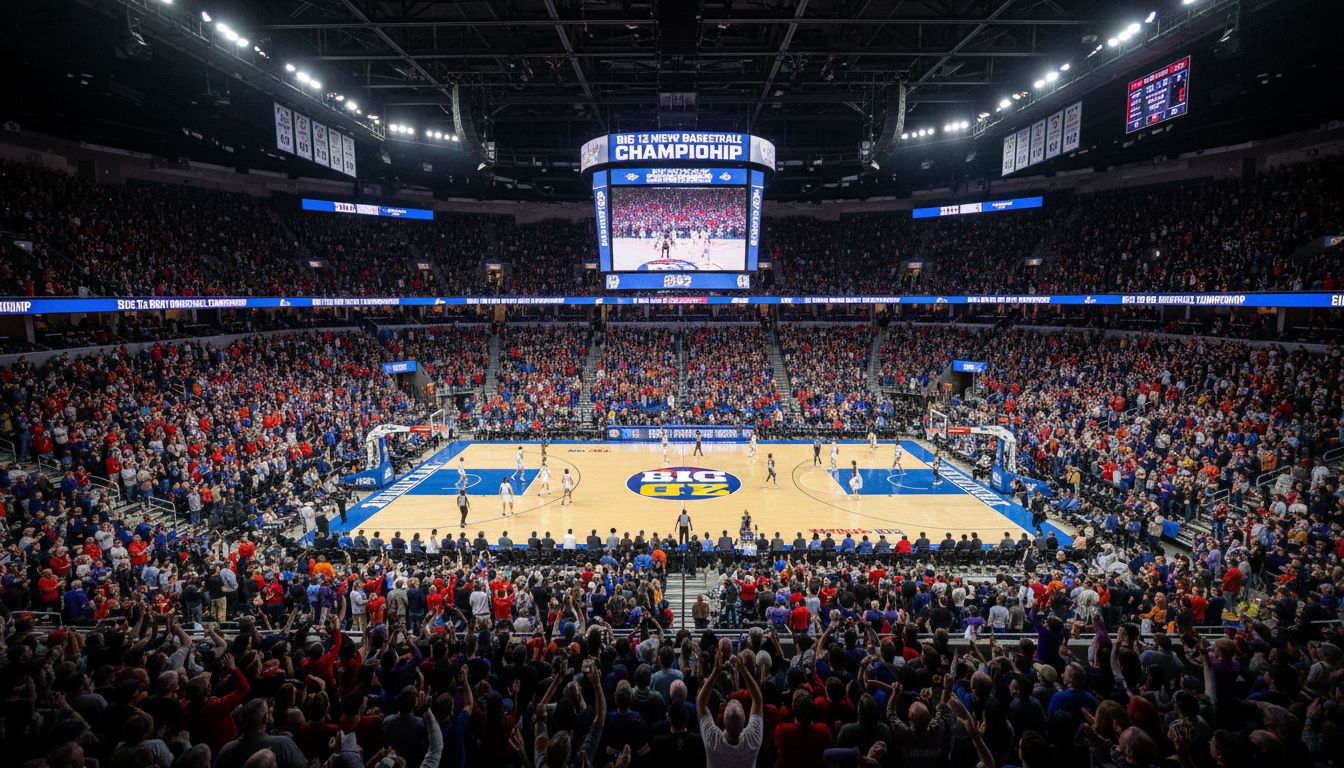
Walk into any coffee shop in Lawrence this week and the TVs are tuned to the same thing: the Big 12 tournament in Kansas City. For those of us who grew up measuring March by how often Kansas cut down nets at the T-Mobile Center (or Kemper before that), 2026 already looks and feels different. You glance at the bracket and see something that would have made old-timers at Allen Fieldhouse spit out their black coffee: No. 1 seed Arizona versus No. 2 seed Houston for the conference title. Kansas is still there, of course, carrying the No. 3 seed and Bill Self’s usual expectations, but this week has been a reminder that the Big 12 has turned into a true national league. From Arizona State to UCF and BYU, it’s less a regional conference now and more an interstate highway system of hoops.
Start with the basics: the entire tournament is once again parked in Kansas City’s T-Mobile Center, with games running March 10-14 and the title game on Saturday night. The bracket this year has Arizona on the top line, followed by Houston, Kansas and Texas Tech rounding out the top four seeds. Underneath them you’ve got a pack of dangerous teams: Iowa State at No. 5, TCU at No. 6 and West Virginia at No. 7, the sort of middle tier that has ruined many a favorite’s week in KC. The early rounds delivered exactly what you’d expect from this league: a couple of blowouts, a couple of near-upsets and at least one game that had you wondering if anyone remembered how to guard a ball screen. By the time we reached the semifinals, though, the chalk mostly held, and the power at the top separated itself from the rest.
If you’re looking for the defining performance of the early rounds, Iowa State’s 91-42 demolition of Arizona State in the second round jumps off the page. That’s not a basketball score so much as something you see on a Friday night in high school when one team forgets to get off the bus. The Cyclones followed that up by thumping No. 4 seed Texas Tech 75-53 in the quarters, playing the kind of physical, connected defense that travels in March. For all the talk about TV markets and realignment, this is still the same basketball truth Dr. Phog Allen preached a century ago in Lawrence: defend, rebound, and you’ll hang around any game. Iowa State rode that formula all the way to a near-upset of Arizona in the semifinals, falling just short, 82-80, in what might have been the game of the tournament.
On the other side of the bracket, UCF and BYU did their best to remind everyone that the league’s newer faces aren’t just here to fill out the census data. UCF edged Cincinnati 66-65 in overtime, a grinder of a game where every possession looked like it had been negotiated by committee. BYU, meanwhile, poured in 105 points on Kansas State in the first round, then turned around and held West Virginia to 48 in the second, which is about as dramatic a style swing as you’ll ever see in back-to-back games. Those performances didn’t quite translate into giant-killing in the quarters—Houston outlasted BYU 73-66 and Arizona handled UCF 81-59—but they did reinforce a theme: there are no easy scouting reports in this league anymore. From a coaching-tree perspective, it’s exactly the kind of competitive ecosystem that sharpens staffs, rewards adjustments and exposes any program trying to live on reputation alone.
For Kansas fans, the path felt familiar at first. The Jayhawks handled TCU 78-73 in the quarterfinals, a workmanlike win that fit neatly into the Bill Self era template: toughness on the glass, timely shot-making and just enough half-court execution to close it out. Kansas may not have come in as the No. 1 seed this time, but a top-three line in the Big 12 is still a pretty good proxy for national relevance. Then came the semifinal against Houston, and that’s where the story took a turn. Houston’s 69-47 win over Kansas wasn’t just a bad night at the office; it was a statement that the Cougars’ brand of defense-and-glass basketball is built to survive deep into March, even against bluebloods.
From a neutral lens—and I say this as someone who still gets goosebumps walking into Allen Fieldhouse—that semifinal was a clinic in what modern, high-pressure defense looks like. Houston smothered Kansas on the perimeter, disrupted timing on ball screens and turned normally clean Jayhawk sets into late-clock improvisation. When you hold a Bill Self offense to 47 points, you’re not just having a hot night; you’re dictating terms on almost every trip. In a way, it echoed some of the best Self-era wins where Kansas flipped the script on opponents with physical defense and rebounding, only this time the Jayhawks were on the receiving end. For the Big 12 as a whole, it underscored something important: the league’s identity as a defense-first gauntlet didn’t leave when the membership changed; it just spread to new ZIP codes.
That sets up a championship game that would have sounded like a preseason nonconference showcase five years ago: No. 1 Arizona versus No. 2 Houston, both wearing Big 12 patches on their jerseys. Arizona reached the final by grinding past Iowa State in that 82-80 thriller, showing they could win when the pace slowed and the possessions got precious. Houston’s route, capped by the win over Kansas, was more methodical—less fireworks, more slow squeeze, the basketball equivalent of a boa constrictor closing in. As a Midwesterner, you can’t help but notice the geographic whiplash: a league that once ran largely along I-35 now spans desert to Gulf Coast, yet converges each March on downtown Kansas City like it always has. If there’s a constant in all this change, it’s that the T-Mobile Center still feels like a second home court for Big 12 fans, especially those in crimson and blue making the easy drive up from Lawrence.
Zooming out, the 2026 bracket is a snapshot of what the modern Big 12 has become: deep, unforgiving and a little bit wild around the edges. Arizona and Houston grabbing the top two seeds is a reminder that traditional power doesn’t just live in the old Big Eight footprint anymore, and that’s healthy for the league, even if it tests our nostalgia. Programs like Iowa State, TCU, and UCF showed that the middle of the conference is fully capable of swinging momentum in a single week, the way Missouri or Oklahoma State used to back in the day. Kansas, for its part, is still firmly in the national conversation despite the semifinal stumble—this is a program built on resilience, from Phog Allen to Bill Self, and one March setback in Kansas City has never defined a season. If anything, tournaments like this one reaffirm why Big 12 basketball remains must-watch TV: it’s where tradition meets realignment reality, and the basketball in between is as competitive as anywhere in the country.
For fans around here, the challenge is holding two truths at once: you can miss the old rivalries and still appreciate the new ones taking root. Arizona versus Houston for a Big 12 title might not stir the same emotions as a Border War showdown, but it still reflects the core value that built this league—high-level basketball played in front of fan bases that care deeply. From a coaching-history standpoint, you can already see the next generation of stories forming: staffs adjusting to new travel, new recruiting territories and new stylistic clashes. And in Lawrence, when folks gather to rehash this tournament over coffee or at church on Sunday, the consensus will probably land somewhere sensible and very Kansas: tip your cap to Arizona and Houston, learn from Houston’s blueprint, and trust that Allen Fieldhouse will still be rocking next winter. Because in the end, conferences realign, brackets change, and seeds rise and fall, but around here one rhythm stays the same—come March, we check the bracket, circle Kansas City, and whisper the same three words: Rock Chalk Jayhawk.