Every January, college basketball’s power rankings start to look less like a fun parlor game and more like a crude map of who might still be standing in April. Buried inside this week’s shuffle is a question I find more interesting than whether Arizona can stay undefeated or if Michigan’s pace will hold: what does a real contender actually look like in 2026?
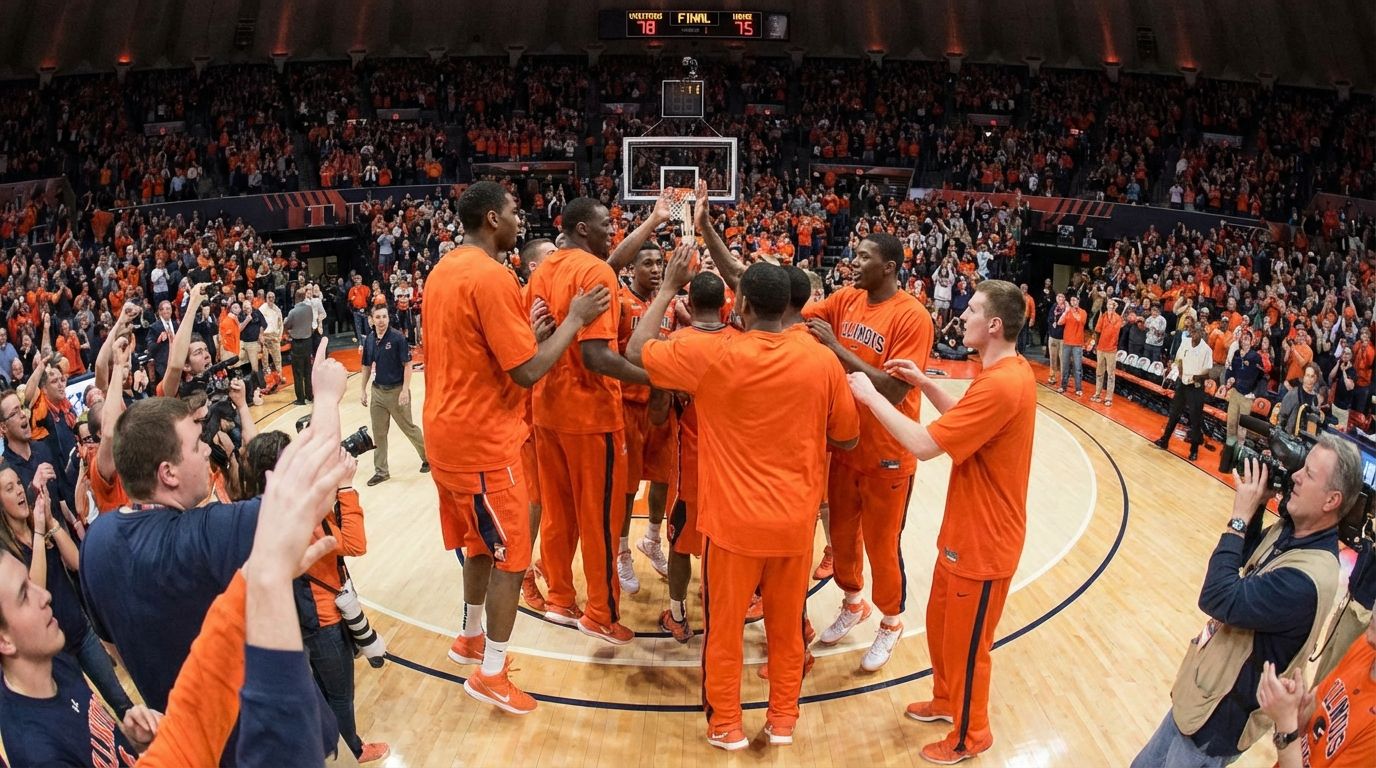
Illinois, of all programs, has become the latest test case, straddling that uneasy line between analytics darling and fan-base trauma response. Last year the Illini were a classic paper tiger, devouring Quad 4 opponents and shrinking against elite competition; this year, they own the best offense in KenPom history and just walked into Purdue and left with an 88-82 win.
Start with Illinois because their transformation is the most dramatic, and also the most instructive. They’ve won 12 straight, they are the tallest team in the country by average height, and they live on the offensive glass like it’s rent-controlled housing they’re never giving up.
Defensively, they finally protect the rim without hacking, which is the bare minimum if you plan to share a bracket line with the blue bloods. The starkest contrast with last season is where their dominance shows up: instead of bullying only bad teams, they’re now putting separation between themselves and a reigning power like Purdue.
If you’re inclined to view sport through systems rather than heroics, the Illini look less like a collection of hot hands and more like a coherent structure that can travel—big, physical, and versatile enough to win in multiple ways.
Of course, this tidy structural reading crashes into the messy, glorious outlier that is Keaton Wagler’s recent explosion. Wagler’s 46-point masterpiece at Purdue—13-for-17 from the field, 9-for-11 from deep, 11-for-13 at the line—was not just a shooting clinic; it was a reminder that even in a hyper-analyzed sport, a freshman can still hijack the script.
Over his last dozen games, he’s at 20.1 points, 4.8 rebounds and 5.3 assists, while flirting with 50/47 shooting splits. Numbers like that risk turning any writer into a cheerleader, but the more interesting question is whether his usage amplifies Illinois’ strengths or conceals potential structural gaps, particularly when Kylan Boswell is out.
For now, though, the evidence leans toward amplification: Wagler’s gravity opens the floor for those towering lineups, and the result is an offensive profile that isn’t just efficient—it’s historically loud.
Zoom out from Champaign and you see an ecosystem in flux at the top of the rankings, where unbeaten Arizona sits at 22-0 but hardly untouchable in the micro sense. Their win at BYU looked brutal in its physicality, with Jaden Bradley and Brayden Burries combining for 55 points, seven assists and five steals, and their perimeter defense turning one of the country’s most gifted guard trios into a bricklaying symposium.
Yet even there, it took about 65 seconds of late-game chaos to remind us that unbeaten records are often a story of surviving your own lapses more than simply overwhelming everyone else.
UConn, sitting just behind at 22-1, embodies a different tension: elite defense paired with an offense that’s drifting toward ordinary, ranking only 40th in efficiency and hemorrhaging defensive rebounds over the last six games. If Arizona’s profile whispers inevitability, UConn’s murmurs volatility—plenty good enough to win a title, but also oddly dependent on winning knife-fight games they used to blow open by halftime.
The Big Ten, often caricatured as a plodding league, is quietly staging a stylistic argument with itself. Michigan, once the nation’s fastest team, has been dragged into the half court since early January, slicing its fast-break output from 17.5 to 10.3 points per game and watching its margin of victory compress in real time.
Michigan State, meanwhile, is living through the age-old experiment of how much on-ball genius a point guard can supply before the system bends around him; Jeremy Fears Jr. is posting 16.8 points and 8.0 assists in conference play with scarcely any turnovers. Fears recently responded to criticism with a standout performance of 26 points and 15 assists in an overtime win against Illinois.
Purdue offers the cautionary tale on the other side: a three-game skid where defensive leaks coincided with the quiet disappearance of its supporting cast, as Fletcher Loyer and Oscar Cluff both saw their production crater. However, Loyer has recently broken out of his slump, hitting 10 triples in his last two games.
Further west, Iowa State’s Milan Momcilovic is engaged in his own private dialogue with the laws of shooting regression, knocking down 54% of his threes overall and somehow better in Big 12 play, while ranking second nationally in makes from deep.
Texas Tech, which just handed Houston a defensive meltdown, has built a top-tier offense not just on star power—Christian Anderson and JT Toppin—but on role players like Donovan Atwell catching fire from three. However, Texas Tech recently suffered an upset loss to Arizona State, with star forward JT Toppin leaving the game due to a leg injury, raising concerns about his availability for future games.
BYU finds itself in a strange liminal space: analytically sparkling, perched high in the NET, but still hunting that elusive Quad 1A win that would transform their résumé from intriguing to undeniable. For the first time since 2020, BYU has defeated a top-six AP team, taking down Iowa State 79-69, with Dybantsa leading the charge with 29 points, 10 rebounds, and nine assists.
Kansas, after a wobble, has quietly rediscovered its defensive snarl, holding recent opponents under 38% on twos while Flory Bidunga turns every paint touch into an almost automatic bucket. However, Kansas suffered a historic home loss to Cincinnati, marking its largest home loss under Bill Self and its first double-digit home loss to an unranked opponent since 1993.
And somewhere in the background, Miami (Ohio) and Saint Louis keep stacking wins, proof that not all relevant basketball stories are confined to the power conferences, even if the cameras often are. Miami (Ohio) remains undefeated, recently defeating UMass to improve to 26-0, marking the longest-ever MAC winning streak.
The human stories threaded through these numbers are the real reason to care, at least for those of us who don’t believe sport is purely a meritocratic algorithm. Houston freshman Kingston Flemings dropping 42 points in a loss, becoming the first Kelvin Sampson player to crack 40 since 1989, is not just a stat—it's a small rebellion against the system’s preference for winners as the only acceptable protagonists.
Vanderbilt’s Tyler Tanner rebounding from a rough patch to lead back-to-back blowouts, or Virginia’s Sam Lewis quietly functioning as the barometer for the Cavaliers’ success, complicate the simple binary of contender and pretender.
And in Tennessee, Ja’Kobi Gillespie and Nate Ament choosing this exact moment to play their best basketball reshapes not only their own ceilings but the entire SEC hierarchy. Ament recently scored 29 points and grabbed eight rebounds in a loss to Kentucky.
What emerges is less a clean ranking than a shifting web of interdependence, where one freshman’s burst or one veteran’s slump can rewire who gets framed as legitimate and who is dismissed as a nice story.
So, is Illinois a Final Four contender? On paper, absolutely: historic offense, elite size, sustainable shot quality, and a star who can torch a top program on the road.
In practice, they’re something both more and less definitive: a team that seems to have learned from last season’s illusion, built a sturdier identity, and accepted that there’s no shortcut around playing well against actual good teams.
The schedule will harden in the coming weeks, and the absence of Kylan Boswell will test just how transferable this offensive machine really is. But if we care about process as much as outcome—and we should—Illinois has moved from paper tiger to something more substantial, the kind of team you wouldn’t mind tethering your March emotional stability to, if you’re brave enough to try that again.
Stepping back, these rankings double as a reminder of how we talk about power in sport more broadly. We tend to crown the unbeaten, obsess over the blue bloods and reduce everyone else to narrative garnish, even when programs like Saint Louis or Miami (Ohio) are quietly rewriting their own histories.
A more honest reading of this landscape isn’t about who sits atop a weekly list but about who is fundamentally equipped to adapt—to injuries, to tougher schedules, to the randomness that March always delivers. Right now, Arizona and Illinois look built for that adaptation; UConn and Purdue feel like they’re still negotiating with their flaws in public.
If there’s any comfort for the rest of us watching from couches and crowded bars, it’s this: no matter how advanced the metrics get, the sport stubbornly resists total predictability, leaving just enough room for chaos, surprise and the occasional 46-point freshman performance to redraw the map overnight.
Michigan, now ranked No. 1 in the AP poll for the first time since 2013, faces a crucial week with games against Purdue and Duke. Their upcoming clash with Purdue is pivotal for the Big Ten title race, and the showdown with Duke is set to be a marquee nonconference matchup.
Michigan's defense remains the best in the country, particularly in the second half, and its offense is known for creating layups or dunks while limiting them for opponents. This week will test their ability to maintain focus and dominance as they navigate a challenging schedule.
Michigan began Saturday at the top of the college basketball hierarchy, enshrined during the March Madness bracket preview as the No. 1 overall seed. By the end of the day, the picture looked a little different, as No. 3 Duke's thrilling 68-63 win over the No. 1 Wolverines muddied up the race for the top spot in the NCAA Tournament bracket yet again.
No. 4 Arizona threw its name into the hat with a 73-66 win at No. 2 Houston while playing without star forward Koa Peat. The takeaway from those two top-five battles is that there are now three 25-2 teams from three different conferences with impeccable credentials heading into the final week of February.
The NET rankings provide a deeper dive into team performance, highlighting UConn's recent recovery with wins against Creighton and Villanova, and Houston's struggles with a three-game losing streak against ranked opponents. Illinois remains 4th in NET after a dominant win over USC and a close overtime loss to UCLA.
Arizona's resilience is noted as they continue to perform well despite the absence of Koa Peat, maintaining their position in the top rankings. The NET rankings also reveal the shifting dynamics of teams on the bubble, with Minnesota and Arizona State making notable moves.
The top of the men's college basketball Power Rankings has remained pretty stagnant for weeks now. Arizona hasn't lost all season; UConn hasn't lost since Nov. 19; Michigan lost to Wisconsin on Jan. 10 but never dropped lower than No. 3; and Duke hasn't lost since Dec. 20.
Even Illinois, the newest member of the top five, is riding a 12-game winning streak and hasn't lost since Dec. 13. But we might be on the precipice of a major shift.
Before the next edition of the rankings, four of our top-five teams have road games against other top-25 teams on their schedules. Arizona plays at Kansas on Monday; UConn heads to St. John's for its toughest remaining regular-season game Friday; Duke goes down the road to rival North Carolina on Saturday for ESPN's College GameDay matchup; and Illinois has a prime-time showdown at Michigan State on Saturday night.
And, lest you think Michigan has an easy road this week, the Wolverines have a pre-Super Bowl rivalry game at Ohio State on Sunday. According to the BPI, UConn and Illinois are both underdogs, and Arizona should be favored by only 1.9 points.
We could see a vastly different top-five landscape come next Thursday. Nebraska fans have been upset that the Huskers weren’t in the top five earlier.
I understand, but I think many are blinded by the word 'undefeated.' Watching Nebraska step on the gas in the second half at Minnesota was impressive, though.
This upcoming week is their ultimate proving ground: at Michigan and hosting Illinois. Even if they go 1-1, I’ll likely keep them in my top five.
Please don’t take Duke star forward Cameron Boozer for granted. He dropped 32 points, nine rebounds, five assists and three steals in a win over Wake Forest.
He’s not as athletic as Dybantsa or Peterson, but he has been asked to do more for his team than any player — and he continues to deliver.
UConn keeps winning, and the Huskies drop a spot? Yes, but just one.
I don’t have hard and fast rules for my rankings. UConn is still awesome, but it has looked vulnerable in the Big East.
The Huskies pulled out their second overtime win in three weeks on Saturday over Villanova. Guard Solo Ball led the way with five triples, breaking out of a shooting slump.
I just keep waiting for UConn to stomp on teams, and it hasn't been able to do that. The Wolverines have been playing with their food lately.
They beat Indiana by 14 and then Ohio State by 12 to boost their record to 18-1. They're a bit under the radar right now, but that all changes this week when they host undefeated Nebraska (20-0) on Tuesday night.
I still believe Michigan has the highest potential of any team in the country. When the Wolverines play well, no other team can touch them.
I was in Tucson, Arizona for the Wildcats' win over Cincinnati on Wednesday. It wasn’t a pretty victory, but it did highlight a lesser-known freshman, forward Ivan Kharchenkov, who was all over the floor on both ends.
Pound for pound, Arizona is the strongest team — physically and mentally — in the country.
The new source article highlights that Arizona, Miami (OH), and Nebraska are the three remaining undefeated teams as of late January. Arizona has a challenging schedule ahead, including games against BYU and Houston, while Miami (OH) benefits from a weaker schedule in the MAC. Nebraska's reliance on 3-point shooting and upcoming games against Michigan and Illinois present significant tests.