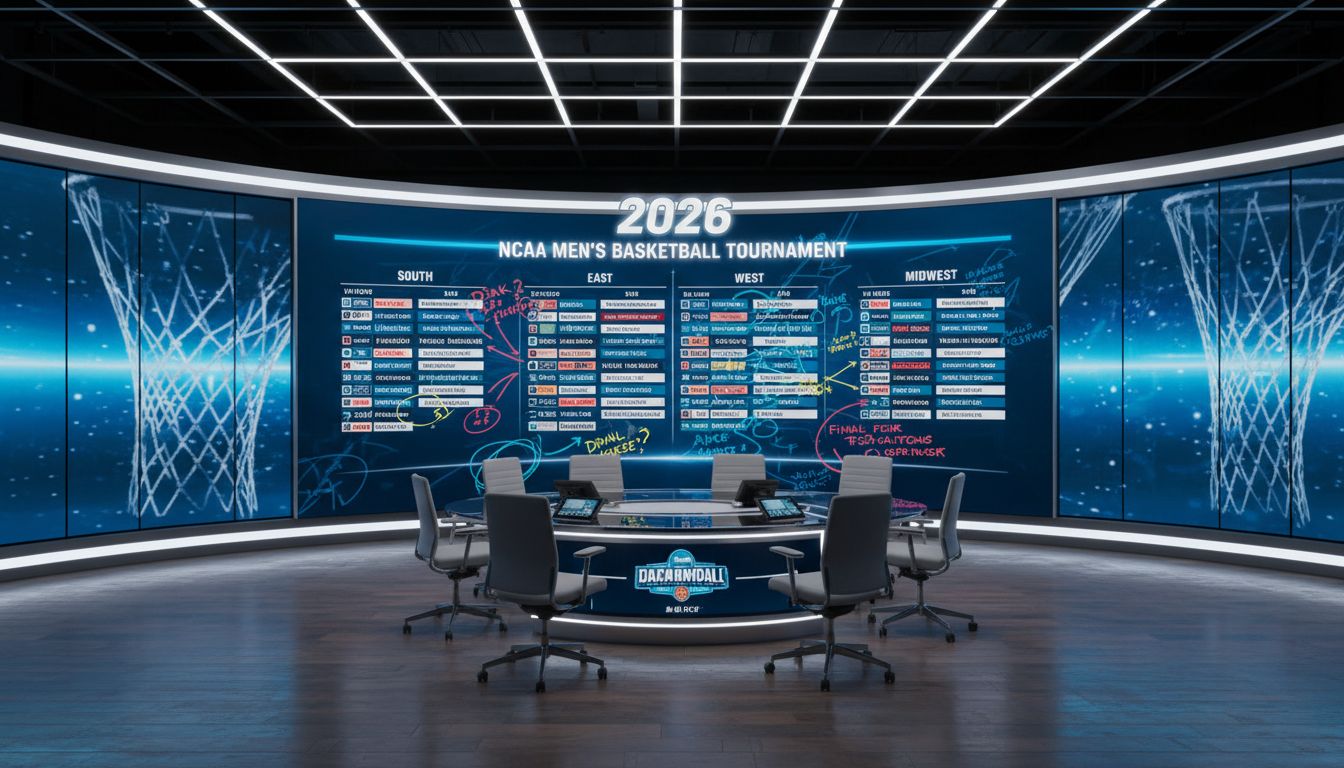
Every March, bracket season separates the romantics from the realists, and this year’s survey of 60 ESPN analysts is an unusually clean window into how the basketball establishment views the 2026 field. Strip away the graphics and the bracket bravado, and you’re left with a consensus that is surprisingly conservative: trust the blue bloods, trust the high seeds, and trust programs that have already proven they can live for three weeks under bright lights. From my little corner in Durham, where banners outnumber losing seasons, I tend to view these things as a study in institutional memory more than a guessing game. Analysts aren’t merely forecasting outcomes; they are, consciously or not, voting on which programs they believe are structurally built to withstand the volatility of March. This year, those votes cluster around a familiar set of names: Arizona, Duke, Michigan, Houston, and the defending champion Florida.
Begin in the South, the only region where the No. 1 seed did not command the room. Instead, the majority of ESPN’s panel hitched themselves to No. 2 seed Houston, last year’s runner-up, chosen by 34 of 60 voters to win the region. That tells you two things immediately: first, that the room believes in Kelvin Sampson’s defensive infrastructure and continuity; second, that there is lingering skepticism about the South’s top seed relative to the Cougars’ battle-tested profile. Houston’s path is complicated by the presence of Florida, the very team that denied the Cougars a title last season, and nearly half of ESPN’s Tournament Challenge players expect a rematch in the Elite Eight. When public brackets and expert picks converge on the same late-round matchup, it often means the underlying metrics and the eye test are in rare agreement.
The East, by contrast, is almost tediously straightforward: Duke, the No. 1 overall seed, hoarded 39 of 59 recorded votes to win the region. To the neutral, that may simply read as respect for the nation’s top résumé; to anyone in Durham, it feels more like a correction after a few years of recalibration in the post–Coach K era. Former head coaches like Jim Boeheim and Tom Crean, along with Joe Lunardi, whose final bracket correctly identified the entire field, are firmly on the Duke side of the ledger. What makes this interesting analytically is not that Duke is favored, but that the dissenters are clustered among specific challengers: 2-seed UConn, chasing a third title in four years; 3-seed Michigan State, angling for its first Final Four since 2019; and 5-seed St. John’s, which just swept both Big East crowns from UConn. Those outlier picks suggest that, while the consensus respects Duke’s balance and top-line talent, there remains healthy skepticism about any team navigating a region stuffed with recent champions and a surging Red Storm.
Over in the West, the analysts essentially anointed Arizona as regional royalty before a ball is tipped: 50 of 60 respondents picked the Wildcats to emerge. That level of agreement is rare and, frankly, a little unnerving for a program whose most famous March moments include more heartbreak than hardware since 1997. Supporters point to Arizona’s power-conference title and a recent, high-level win over Houston as evidence that Tommy Lloyd’s group has already demonstrated its ability to thrive against athletic, physical opposition. Still, the remainder of the votes splitting evenly between 2-seed Purdue and 4-seed Arkansas is a quiet reminder that stylistic contrast matters in March: Purdue’s size and methodical offense present one kind of challenge, while Arkansas’ SEC-tested athleticism offers another. If Arizona stumbles, it will likely be less about seed line and more about how their tempo and spacing handle one of those contrasting archetypes in a pressure setting.
The Midwest is where the chalk dust gets kicked up a bit. Top seed Michigan leads the way with 31 votes, while 2-seed Iowa State draws 21, but this region produces the widest distribution of alternative picks. No. 3 Virginia has its believers, including Ryan McGee, whose show title "Never Tell Me The Odds" doubles as a mission statement when one selects Tony Bennett’s deliberate Cavaliers in a tournament that increasingly favors pace and versatility. A lone analyst each backed Alabama and Texas Tech, and Tom Hart went so far as to anoint 6-seed Tennessee as his Final Four choice. This scatter tells us that the Midwest is perceived as structurally unstable: strong at the top, but lacking the overwhelming favorite that scares analysts away from taking a swing on a contrarian path.
When you zoom out from the regions and look at national-champion picks, the story sharpens considerably: Arizona commands 33 of 60 votes to cut down the nets in Indianapolis. In other words, more than half of a fairly seasoned panel is willing to overlook almost three decades without a title and embrace the Wildcats as this year’s most complete team. Michigan, with 10 votes, occupies the second tier of belief, aiming to end an even longer drought dating back to 1989. Duke sits just behind in raw count, with nine voters trusting the Blue Devils’ combination of star power and depth enough to survive six games, while Florida, Houston and a solitary vote for Purdue round out the field of realistic champions. For all the talk of chaos, these distributions underscore a simple point: at the macro level, the experts still trust high seeds from power leagues with recent success or clear NBA-caliber talent.
Is that conservatism wise or timid? From an old-money centrist’s vantage point, there is a certain comfort in the fact that programs with institutional resources and coaching stability continue to dominate March expectations. These are athletic departments that invest heavily in analytics, nutrition, facilities and recruiting, and it would be naïve to pretend those structural advantages don’t translate into bracket confidence. At the same time, the panel’s willingness to sprinkle in picks like Virginia, St. John’s, Tennessee and Arkansas suggests an appreciation for stylistic diversity and defensive outliers – the very ingredients that have historically birthed Cinderellas and bracket-busting runs. The difference now is that many of those "surprises" come from well-resourced programs rather than true mid-major upstarts, which is its own quiet commentary on where the sport’s competitive balance has drifted.
From a tactical standpoint, several themes unite the teams drawing the most support. Arizona, Duke and Michigan all marry efficient offensive spacing with multiple shot-creators, and they defend well enough at the rim to avoid easy run-outs the other way. Houston and Florida carry the profile of physically mature, switchable defenses that can smother less polished guards over 40 minutes, while UConn’s dynasty bid rests on its ability to overwhelm opponents on the glass and win the math game through threes and free throws. The contrarian darlings, like Virginia and Tennessee, lean into tempo and half-court discipline, betting that they can drag more athletic opponents into games played in the low 60s. In that sense, the ESPN picks aren’t just predictions; they’re a referendum on which modern archetype – pace-and-space offense or strangling defense – coaches and analysts truly trust when everything tightens.
If you’ll indulge a brief local aside, the Blue Devils’ status as overwhelming East favorites and a plausible national-champion pick is less about sentimentality and more about construction. This is a roster built with the tournament in mind: multiple ballhandlers, switchable wings, and enough length to guard every position without abandoning the three-point line. The selection of Duke by figures like Boeheim and Lunardi, who have no incentive to pander to Cameron, suggests that the program’s post–Coach K recalibration is largely complete. Whether that translates into another banner is, of course, up to the players; but for the first time in a few years, the external expectations match the internal standard those rafters quietly demand.
Ultimately, the ESPN panel’s picks offer less a prophecy than a map of perceived power in the sport right now. Arizona sits at the center of that map, flanked by Michigan and Duke, while familiar names like Florida, Houston, UConn and Michigan State hover in the next orbit of trust. The true test will come, as it always does, when one of those comfortable, consensus choices runs into an underseeded, overcoached opponent with a chip on its shoulder and a senior point guard who refuses to blink. Your task as a bracket maker is to decide where you believe the experts are leaning on sound structural logic – and where they are simply following the safest path. If you’re inclined to shade your picks toward the traditional powers, you’re in good company; just don’t be surprised if, two weeks from now, we are all pretending we saw this year’s surprise interloper coming from the very start.