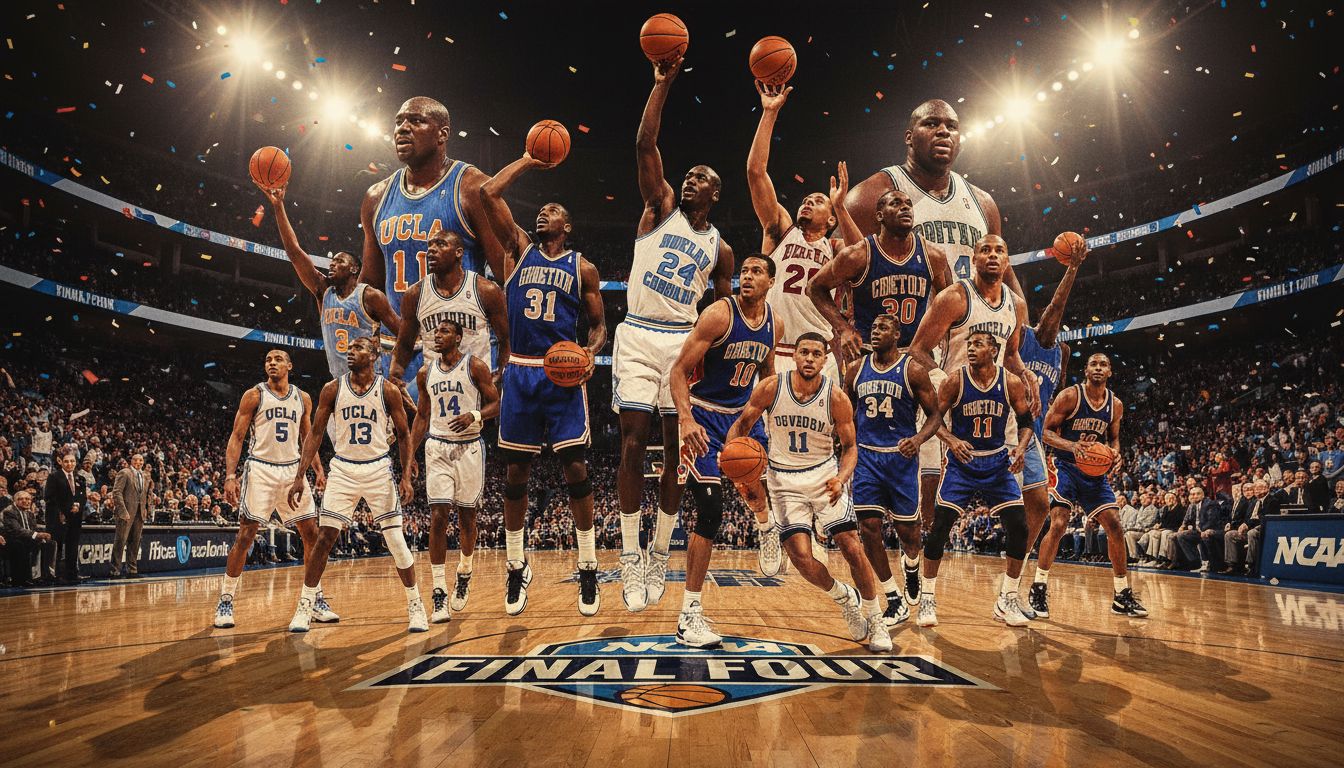
Scroll that Most Outstanding Player list from Jimmy Hull in 1939 to Walter Clayton Jr. in 2025 and it feels like flipping through a living scrapbook of college hoops history. You see eras change in real time: the big man dynasties, the point guard revolutions, the one-and-done takeover, and now the NIL era where a hot March can flip a player’s entire life overnight. It’s a highlight reel of legends — Kareem back when he was Lew Alcindor, Bill Walton going 21-of-22, Magic turning the Final Four into a Showtime trailer, Kemba Walker and Shabazz Napier dragging UConn on their backs. But if you read that list with a little more intention, a few patterns jump off the page, and so do a few absences. Because for all its magic, the MOP list also tells a story about who gets the ball, who gets the spotlight, and who too often gets left on the outside looking in.
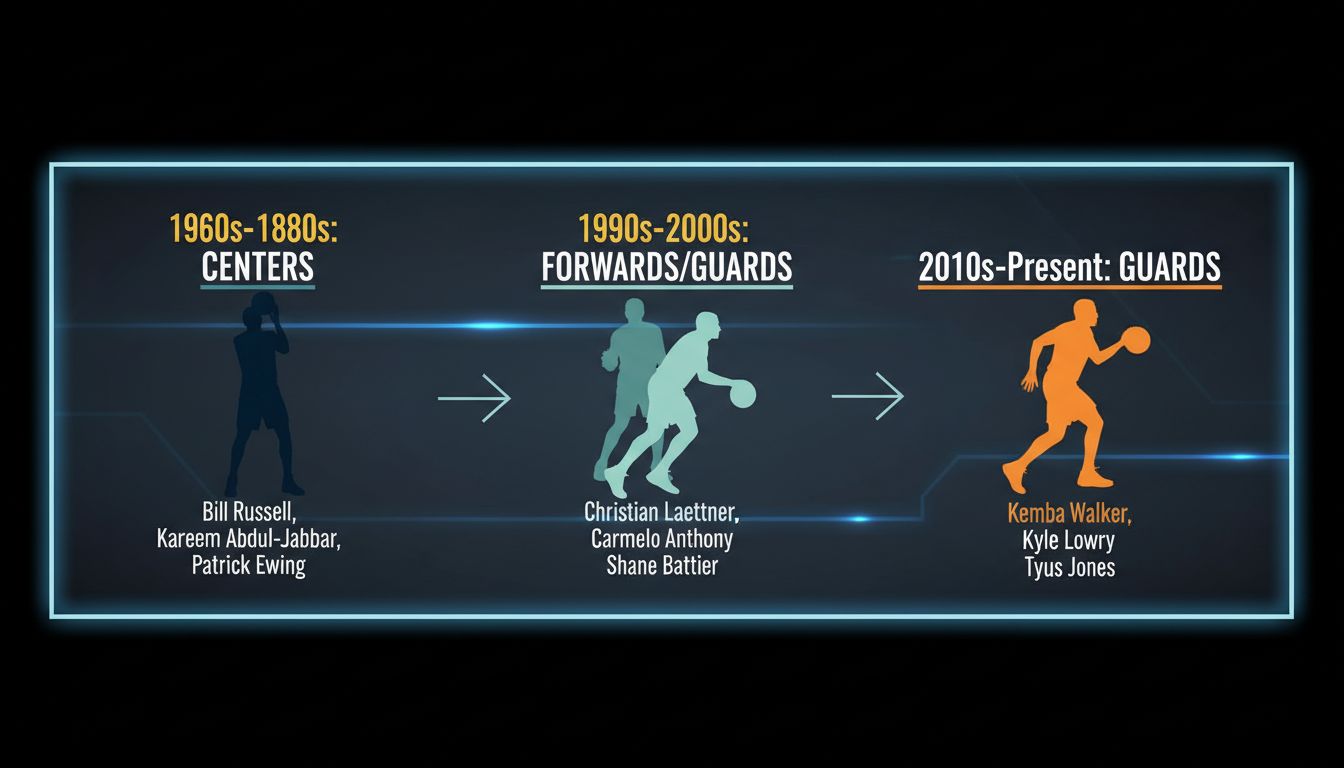
Let’s start with dominance, because the big fellas owned this award for a long time. Kareem – then Lew Alcindor – taking three straight MOPs from 1967 to 1969 is still untouched territory, the basketball equivalent of writing your name in Sharpie across an entire era. Add in double-ups from Bob Kurland, Alex Groza, Jerry Lucas and Bill Walton, and you’ve basically got a big-man Hall of Fame sitting right there in bold print. Walton’s 44-point masterpiece in 1973 – 21-of-22 from the field in a national title game – still reads like a typo, and it capped UCLA’s seven-straight-championship run just as freshmen were finally allowed to play varsity again. For decades, the MOP almost always lived in the paint: Bill Russell, Wilt Chamberlain, Elgin Baylor, Jerry Lucas, Danny Manning, Akeem Olajuwon, Patrick Ewing – if a frontcourt star was carrying their squad deep in March, odds were good they were also carrying home that crystal. It wasn’t just about height; it was about where coaches and systems believed power lived in college basketball.
Then the game sped up, the guard era kicked the door down, and the MOP hardware started landing in the hands of guys who could break a press and hit a step-back. You see it clearly from the late ’80s on: Glen Rice bombing away, Anderson Hunt pushing tempo for that UNLV track meet, Bobby Hurley and Christian Laettner tag-teaming Duke’s rise, then the wave of perimeter killers like Richard Hamilton, Juan Dixon, Carmelo Anthony, Kemba Walker, Shabazz Napier and Kyle Guy. By the time Ryan Arcidiacono is pitching ahead to Kris Jenkins for that Villanova buzzer beater, the DNA of the award has shifted; the ball handler who controls the last five minutes is now just as likely to be MOP as the big man who dominated the first 35. In the 2010s especially, you can feel how much the modern game values shot creation and versatility: Tyus Jones as a freshman closer for Duke, Donte DiVincenzo exploding for 31 off the bench, Tristen Newton calmly steering UConn’s repeat run, Walter Clayton Jr. stuffing the box score in Florida’s 2025 title push. If Kareem’s three-peat was about post dominance, this more recent stretch is about perimeter poise when everything tightens and the season is down to a handful of possessions.
Freshmen, though, are where the story gets really interesting, especially in a post–one-and-done world. For all the hype, this award has only gone to a first-year player a handful of times: Arnie Ferrin back in 1944, then a forty–plus year gap before Pervis Ellison in 1986, followed by Carmelo Anthony in 2003, Anthony Davis in 2012 and Tyus Jones in 2015. Think about that: in the era where elite freshmen are treated like rental Ferraris, Final Four MOPs are still overwhelmingly upperclassmen who have been through some things. Even when a freshman is clearly the most talented player on the floor, like Davis in 2012, the stat line in the title game – six points on 1-of-10 shooting – reminds you that the moment can bend differently than the box score. Davis still locked in 16 rebounds, six blocks, five assists, three steals and walked away with MOP because winning and impact still matter more than volume numbers, and that’s one thing this award usually gets right.

If freshmen are rare, sophomores lately are downright endangered. Since 2000, only Joakim Noah, with his 16 points, nine boards and six blocks in 2006, has broken through as a second-year guy, and that drought has stretched more than a decade. That tells you something about how extreme the polarization has become: either you’re good enough to be gone after one year, or you’re sticking around longer to grow into that junior or senior anchor role like Shabazz Napier, Kemba Walker, or Wayne Ellington. The MOP list over the last 20 years is basically a love letter to continuity – to the guys who stayed, took their lumps, and then turned March into a personal revenge tour. There’s a quiet message here for anyone building a roster in the portal and NIL era: culture and cohesion age well in March, even when raw upside gets all the clicks in November.
Of course, not every MOP gets to cut the nets, and that tension is one of the most human things about this award. From Jimmy Hull in 1939 to Elgin Baylor, Jerry West, Wilt Chamberlain and, most recently, Hakeem Olajuwon in 1983, a dozen players have been so brilliant that voters had to honor them even as they watched confetti fall on someone else. Olajuwon might be the clearest example: averaging 20 points, 20 boards and 7.5 blocks in the Final Four, only to walk away as runner-up. Those performances remind us that March isn’t a perfect meritocracy; it’s a one-and-done carnival where a hot shooting night, a whistle, or one broken play can tilt history. Sometimes the greatest individual run doesn’t end with a trophy – but the MOP list makes sure those efforts don’t just disappear into the box scores.
Now here’s where my Philly-and-Howard brain kicks in: scroll that list again and notice who’s not there. You see blue blood royalty, mid-major miracles, West Coast giants and East Coast powers, but you don’t see an HBCU. That’s not about a lack of talent – HBCUs have sent legends to the league and produced some of the best hoopers you’ve never heard enough about – it’s about access to the big stage and the margins these programs are forced to live in. When you’re fighting for at-large respect, playing guarantee games on the road, and often sliding into March as a 15 or 16 seed, it’s a whole lot harder to string together the kind of deep run that puts your star under that Final Four spotlight.
So, when I look at Kareem’s three-peat or Walton’s perfect night or Kemba’s step-backs, I’m celebrating, absolutely – those are sacred tapes in the March Madness vault. But I’m also imagining what it would look like if an HBCU guard, who’s been cooking all year with no TV crew in sight, finally got dropped into that Final Four window with America watching. Because the MOP isn’t just an award; it’s a signal boost. It turns a campus hero into a household name, it changes draft stock, and now in the NIL age, it can literally rewrite a player’s financial reality between Selection Sunday and draft night. Picture the economic ripple if that moment ever belonged to a kid from Howard, Norfolk State, Texas Southern, or any of the HBCUs that have been grinding in the shadows for decades.
That’s why how we talk about this list matters. If we treat it like a closed club of usual suspects, we miss the chance to ask better questions about scheduling, seeding, investment and visibility for programs that sit outside the power structure. If we treat it as a living document, we can celebrate what’s here – from Marvin Huffman’s 12-point night in 1940 to Walter Clayton Jr.’s do-everything 2025 run – and still leave space for the stories we haven’t seen yet. Some future MOP is out there right now, working out in an empty gym, waiting for their bracket to break just right. And if that player happens to be lacing them up at an HBCU when it finally happens, don’t say history didn’t give us enough hints about who’s talented enough – only about who got a real shot at the stage. Until then, this list remains both a love letter to college hoops greatness and a reminder that the Most Outstanding Player isn’t always the most visible one — at least, not yet.