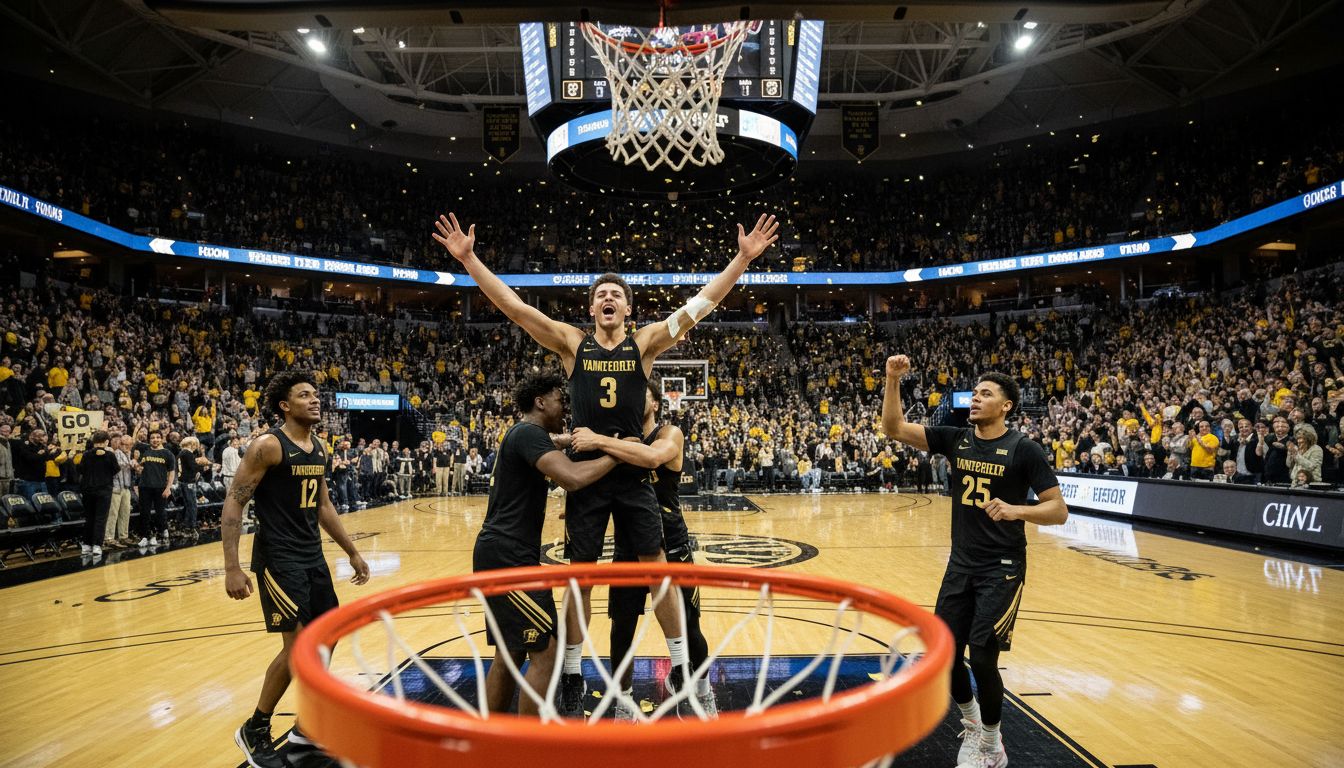
By mid-January, records stop lying in college basketball. You get enough film, enough road trips, enough back-to-backs that the noise starts to shake out and the truth settles in. And the truth this season is that a handful of programs most of us buried in the preseason notes section — Nebraska, Vanderbilt, Seton Hall, George Mason — are suddenly writing themselves into the main script. The box scores tell one story, but inside the locker room these runs feel very different: they feel like proof that belief, fit and opportunity still matter as much as blue-blood pedigree. From a former player’s lens, these aren’t just cute Cinderella anecdotes; they’re case studies in how modern programs can be built, how players can bet on themselves and how coaches can recalibrate culture on the fly.
Take Vanderbilt, whose perfect start just took its first hit but still qualifies as one of the wildest plot twists on the board. Picked 11th in the SEC preseason poll and now sitting in the top 10 of the AP, the Commodores have gone from afterthought to appointment viewing. They’re top-10 nationally in adjusted offensive efficiency, playing with pace, spacing the floor and ranking among the nation’s best in two-point percentage. From a player’s standpoint, that style matters: it’s a system that showcases guards, gives bigs room to operate and feels fun, which is not a trivial thing over a long season. Mark Byington has essentially told his roster, "We’re going to play to your strengths and live with the variance," and buy-in like that is why he’s already on any reasonable Coach of the Year short list.
What Vanderbilt is doing also speaks to the power-balance shift in today’s college game. Players have more freedom than ever through the portal, and offensive systems like Byington’s act like billboards to recruits and transfers: come here, touch the ball, play fast, be seen. It’s player-friendly without being player-run, the sweet spot every modern coach is hunting. When you’re scoring at a top-10 clip nationally and winning, practices feel lighter, film sessions feel collaborative and guys are more likely to speak up when something’s off. That’s the quiet culture piece people on the outside don’t always see — the way a fun brand of basketball can also be a sustainable one if standards stay firm.
On the other end of the stylistic spectrum is Seton Hall, dragged from the Big East basement by a defense that looks like it was built in an old-school Jersey gym with no heat. Last year’s Pirates were 7-25 and landed dead last in the league’s preseason coaches poll; this year’s group has already doubled that win total and is playing like an NCAA Tournament team. They rank top-20 nationally in opponent field goal percentage, steals and blocks, and their overall defensive efficiency sits in the top 15 at KenPom. Offensively, they’re still a work in progress, but the profile is clear: get paint touches, live at the foul line, and let Adam "Budd" Clark put constant pressure on the rim even if he barely looks at a three. From where I sit, this is a roster that’s taken on Shaheen Holloway’s identity — tough, stubborn, unapologetically physical — in a way that gives role players clarity and confidence every night.
Defensive-first teams like Seton Hall can be a grind to play for, but there’s a flip side players appreciate when it’s done right. You know exactly what travels on the road: effort, communication, willingness to guard your matchup for 40 minutes. Holloway’s history with that Saint Peter’s Elite Eight run gives him credibility when he preaches that message; guys know he’s lived it, not just diagrammed it. That authenticity tends to lower the anxiety level in the locker room, because players understand how they’ll stay on the floor — win your matchup, take care of the ball, sprint to your rotations. It’s not glamorous, but for a lot of kids trying to carve out a role and a future, that kind of clearly defined lane can be a blessing.
Then there’s Nebraska, maybe the most staggering surprise of all when you zoom out on program history. The Cornhuskers were picked near the bottom of the Big Ten in preseason projections and have instead opened 16-0 and 5-0 in league play, making Fred Hoiberg a very real National Coach of the Year candidate. This is a program that has never won an NCAA Tournament game — 0-8 all-time — and is suddenly flirting with its best season ever and a shot at finally erasing that number from the broadcast graphics. Forward Rienk Mast, one of the better stretch bigs in the country, is averaging north of 16 points and hitting more than a third of his threes on real volume, giving Nebraska an offensive anchor that warps scouting reports. If you’ve ever sat in a film room as the outmatched underdog, you know how rare it is to feel the room shift from "how do we survive" to "how do we dictate," and that’s the quiet revolution happening in Lincoln right now.
Hoiberg’s pro background shows up not just in his spacing and playbook, but in how he empowers his roster. Stretch bigs like Mast don’t just stretch the floor; they stretch players’ imaginations about what their roles can be if they work and land in the right ecosystem. For a school with Nebraska’s postseason scars, that matters mentally as much as tactically. Winning at this level, especially when you’re rewriting program history, takes a heavy emotional toll — media attention spikes, expectations change, and suddenly every road arena wants its shot at you. How Hoiberg manages that emotional load, how he rotates to protect legs and minds over the grind, may end up as important as any set he draws up in March.
George Mason’s story might be the most quietly impressive of the bunch. Tony Skinn didn’t just lose a couple starters; he lost all nine players who suited up in last year’s A-10 title game through injuries, eligibility and the transfer portal. This season, he’s sitting at 17-1 and 5-0 in conference play after reloading with under-the-radar guys from Presbyterian, Samford, Mount St. Mary’s, Ball State and Northeastern. That’s not just good scouting; that’s deep relational work — convincing players to trust that a coach with his own Final Four pedigree can help them write a new chapter of their careers. The question now is whether he can guide the Patriots back to the NCAA Tournament for the first time since 2011, which would be a full-circle moment for a program still defined nationally by that 2006 run.
Skinn’s rebuild showcases what I’d call the new art of roster construction in college hoops. You’re not just stacking talent; you’re piecing together personalities, usage histories and dreams from a half-dozen different locker rooms into one coherent identity. Hit on those evaluations and you get a team like Mason — veteran, hungry, with a chip but not chaos. Miss, and you end up with a roster that looks great on paper and fractured on the road, the kind that leaks anonymous quotes to reporters by February. So when you see a group of transfers defending for each other, accepting roles and celebrating bench minutes like starter minutes, that’s usually a sign that the coach and staff are winning a lot of quiet conversations behind closed doors.
What ties Vanderbilt, Seton Hall, Nebraska and George Mason together is not just that they’re overachieving, but how they’re doing it. Each program has found a lane that fits its personnel and its history — from Vanderbilt’s free-flowing offense to Seton Hall’s defense-first grind, from Nebraska’s stretch-big centerpiece to Mason’s transfer-powered depth. In a landscape that often feels dominated by brand names and NIL headlines, these stories are reminders that there’s still room for vision, development and genuine player empowerment. As March creeps closer, some of these runs will cool off; the sport has a way of regressing flashy records back toward the mean. But if you care about how teams are built and how players are put in position to thrive, these so-called surprises are less about luck and more about alignment — between schemes and skill sets, between coaches’ philosophies and players’ day-to-day realities.